



Conversational AI Marketing in Auckland 2026: Using Chatbots to Win More Customers on Social
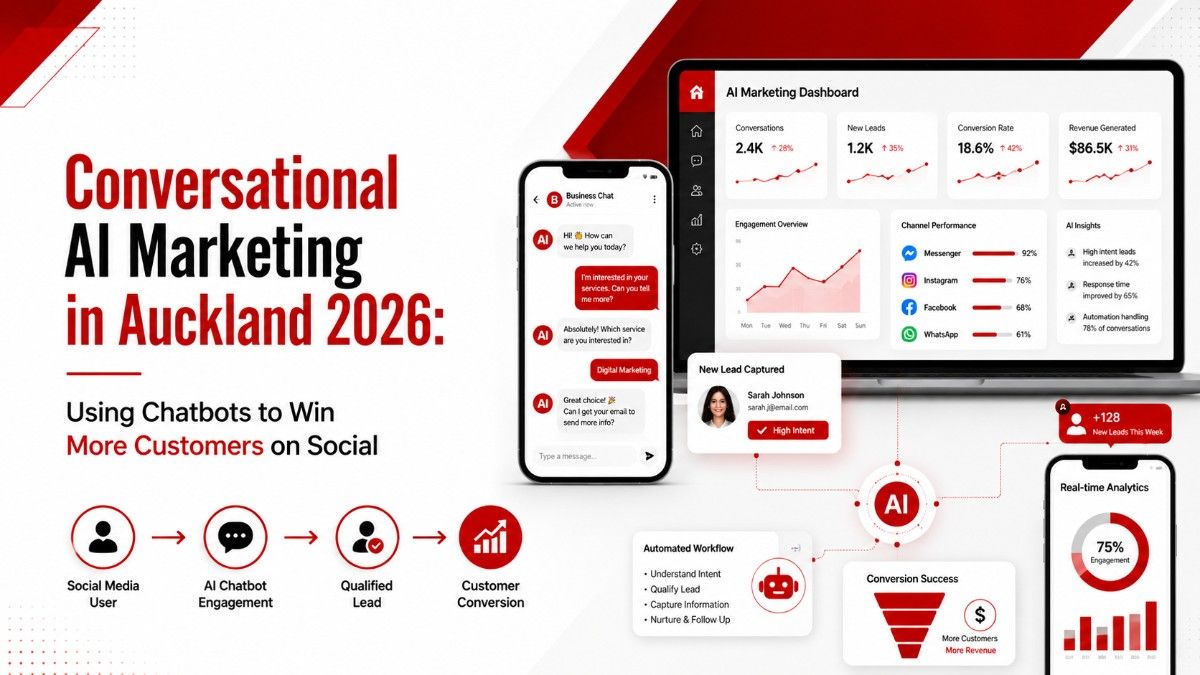
If you own a business in Auckland, you've probably felt this firsthand. A customer sends a message asking about pricing, availability, or whether you can fit them in this week. You're busy. Maybe you're with a client, on a job site, in a meeting, or simply trying to get through the day. By the time you finally see the message, the customer has already moved on. That's the reality many businesses are dealing with now.
People don't expect replies in a few hours anymore. They expect them almost immediately. Whether they're browsing Instagram on their lunch break or sending a Facebook message late at night, they want answers when they're ready to ask. If they don't get one, there's a good chance they'll contact someone else. That's why conversational AI marketing is becoming such a big part of modern customer communication. A few years ago, it felt like something only larger companies invested in. Today, businesses of all sizes are using it because responding quickly has become a genuine competitive advantage.
What Is Conversational AI Marketing?
Quick Answer Section
At its simplest, conversational AI marketing is a way of making sure customer conversations don't stop just because your team is busy. It uses intelligent chat tools connected to platforms like Instagram, Facebook Messenger, and WhatsApp to respond to enquiries automatically, answer common questions, collect contact details, and guide people towards the next step. That could be booking an appointment, requesting a quote, or speaking with a member of your team.
Think of it as a digital assistant working quietly in the background. While you're focused on running the business, the system is answering messages, sorting enquiries, and keeping potential customers engaged. Many Auckland businesses are using conversational AI not because they want to replace people, but because they don't want valuable opportunities slipping through the cracks. A customer sending an enquiry at 10:30pm might not expect to speak with a salesperson, but they do expect some kind of response. Having a system that can acknowledge the enquiry, answer basic questions, and collect key information often makes the difference between winning that customer and losing them to a competitor. In a market where response speed matters more than ever, that's becoming increasingly valuable.
Why Are Auckland Businesses Using AI Chatbots?
- Instant customer responses: People stay highly engaged when a page replies straight away. These systems answer within seconds, holding a user's attention while interest is hot.
- Lead qualification automation: Not every random message is a ready buyer. Chatbots can run through simple screening questions upfront, saving your human reps from wasting hours sorting files.
- 24/7 customer support: People browse at crazy hours. Some of your best leads will come through on weekends or late at night when your office is shut.
- Reduced administrative workload: Most businesses lose hours typing out identical answers to basic questions about pricing, booking procedures, and service locations.
- Improved conversion rates: When a client gets clear facts instantly, they take action faster. Speeding up the conversation directly results in more bookings.
Which Platforms Support Conversational AI?
One of the main reasons this technology scales so well is that it sits right inside the applications your target market already checks daily. Popular setup integrations include:
- Instagram direct channels (handling grid comments, inbox text, and interactive Story loops)
- Facebook Messenger corporate pages
- WhatsApp Business profiles
- Website live chat boxes
- Google Business Profile message threads
The right channel mix depends entirely on your target audience. A retail store might see huge volume through Instagram, while local trades or commercial operations find website chat blocks and WhatsApp lock in better results.
What Results Can Businesses Expect?
While results vary by sector, the final operational benefits follow a very consistent pattern. Brands using automated chat setups regularly secure:
- Rapid first-contact speeds
- Drastic jumps in final lead quality
- Stronger user engagement levels
- Higher total volumes of messages
- Better sales closure figures
- Less administrative burnout for front-desk teams
The real key here is absolute consistency. Instead of desperately hoping someone spots a notification on their phone between tasks, every user gets looking after straight away. That keeps your pipeline moving cleanly.
What Does Conversational AI Marketing Mean for Auckland Businesses in 2026?
How Customer Expectations Have Changed
One statistic says a lot about where customer expectations are heading: research shows that around 82% of customers expect an immediate response when they contact a business with a sales or marketing question. Not a reply later that afternoon. Not a call back tomorrow. An immediate response. That's a major shift from how people interacted with businesses just a few years ago.
Think about how most of us shop today. We scroll Instagram while waiting for a coffee. We send messages during our commute. We browse products and services while sitting on the couch at night. Customers are researching businesses throughout the day, often outside traditional working hours. That's particularly true in Auckland. Someone might discover your business on social media at 9pm, send a quick message asking about pricing, and expect an answer before they go to bed. If they don't hear back, there's a good chance they'll contact someone else.
Social media has changed too. It used to be a place where businesses posted updates and hoped people paid attention. Now it's where customers actively research options, compare providers, ask questions, and make purchasing decisions. For many Auckland businesses, direct messages have become just as important as phone calls and website enquiries. In many cases, the sales conversation now starts in the inbox.
Why Social Media Is Becoming a Sales Channel
Quick Answer: Social media platforms have evolved far beyond brand awareness. Today, they're active sales and customer engagement channels where people discover products, ask questions, compare options, and often make purchasing decisions without ever visiting a website.
The speed of the modern buying journey is remarkable. A customer might see your Instagram Reel over breakfast, send a message asking whether you have availability this week, and be ready to book within minutes. If they get a helpful response quickly, the conversation moves forward. If they don't, they'll often move on. What's interesting is that the businesses seeing the strongest results aren't always the ones with the biggest marketing budgets. More often, they're the businesses that make it easy for customers to get answers and take action. In today's market, responsiveness has become a competitive advantage. For many Auckland businesses, the company that replies first often gets the opportunity to earn the customer's trust—and quite often, their business too.
Why Auckland Businesses Are Investing in Conversational AI
The growing interest in conversational AI isn't really about chasing the latest technology trend. For most Auckland businesses, it's a practical solution to a problem that's becoming harder to ignore. Customer enquiries are arriving from everywhere. Instagram messages, Facebook comments, WhatsApp chats, website forms, Google Business enquiries—the volume keeps increasing. At the same time, finding experienced customer service staff or admin support has become more difficult and significantly more expensive than it was just a few years ago.
Many business owners have seen enquiry volumes multiply without seeing the same growth in available staff resources. A business that was comfortably handling 40 or 50 enquiries a week a few years ago may now be dealing with several times that amount. This is where conversational AI starts making sense. It's not about replacing employees. It's about allowing employees to spend their time where it creates the most value.
Instead of having staff repeatedly answering questions about pricing, availability, opening hours, or appointment scheduling, those routine interactions can be handled automatically. That leaves your team free to focus on sales conversations, customer relationships, and the more complex enquiries that genuinely benefit from human expertise. For many Auckland businesses, that's the real advantage: less time spent on repetitive admin and more time spent growing the business.
You May Also Read This Article: The AI-First Revolution: How Artificial Intelligence Is Reshaping Web Design, Mobile App Development, and Digital Marketing in 2026
How Do Chatbots Work on Instagram, Messenger, and WhatsApp?
Quick Answer: Modern chatbots combine automation with natural language processing to communicate with customers across platforms such as Instagram, Facebook Messenger, and WhatsApp. When a message arrives, the system analyses the enquiry, understands the intent behind it, provides a relevant response, and can collect contact details, schedule appointments, or guide customers towards the next step.
Instagram AI Chatbots
Instagram has become one of the busiest customer communication channels for many Auckland businesses. Someone might send a direct message asking about pricing, reply to a Story, or comment on a post wanting more information. Instead of waiting for a staff member to respond manually, a chatbot can engage immediately. Depending on how it's configured, it can answer common questions, share product or service links, collect customer details, recommend products, schedule appointments, or direct prospects to a booking page. For retailers, beauty clinics, fitness businesses, restaurants, and hospitality venues, this can dramatically reduce the time spent managing enquiries while improving response speed. A customer gets the information they need instantly, and the business avoids losing momentum during the buying process.
Facebook Messenger Automation
Despite being one of the most established messaging platforms, Facebook Messenger remains underutilised by many businesses. The automation possibilities are surprisingly broad. Messenger workflows can be used to answer frequently asked questions, manage event bookings, provide order updates, handle customer support requests, qualify new leads, and route enquiries to the appropriate team member. Imagine a busy Auckland event venue receiving multiple enquiries about private functions every day. Rather than manually collecting the same information repeatedly, Messenger automation can gather dates, guest numbers, budgets, and contact details before a team member becomes involved. By the time the enquiry reaches staff, much of the groundwork has already been completed.
WhatsApp Business Automation
WhatsApp continues to gain popularity across New Zealand, particularly among service-based businesses. Trades businesses, real estate agencies, healthcare providers, consultants, and professional service firms are increasingly using WhatsApp to communicate with customers because it feels familiar and easy to use. Common applications include appointment reminders, quote follow-ups, booking confirmations, customer support, project updates, and initial lead qualification. Customers appreciate the convenience because the interaction feels similar to sending a normal text message. Businesses appreciate it because conversations remain organised and scalable even as enquiry volumes increase.
How AI Understands Customer Intent
One of the biggest reasons modern chatbots feel far more natural than older automated systems is their ability to understand intent rather than relying on exact keywords. This is made possible through Natural Language Processing (NLP). Instead of looking for one specific phrase, modern AI can recognise multiple ways of asking the same question. For example:
- "What are your rates?"
- "How much do you charge?"
- "What's the cost of a consultation?"
- "Can you give me an idea of pricing?"
While the wording is different, the intent remains the same. The customer wants pricing information. Modern AI systems recognise this context and respond appropriately. This is particularly valuable in a diverse city like Auckland, where customers communicate in different ways, use different expressions, and bring different cultural communication styles into conversations. Rather than forcing customers into rigid menu structures, NLP helps create a more natural and intuitive experience.
.jpeg)
How Are Auckland Businesses Using Social Chatbots for Lead Qualification?
What Is Lead Qualification?
Quick Answer: Lead qualification is the process of identifying which prospects are genuinely likely to become customers based on factors such as budget, needs, timeline, and buying intent. In simple terms, it's a way of separating serious enquiries from casual interest.
Traditionally, this required manual effort. Business owners and sales teams had to contact every prospect individually, gather information, and determine whether the opportunity was worth pursuing. That approach worked when enquiry volumes were lower, but it becomes difficult to sustain as businesses grow. Messages arrive outside business hours, enquiries come through multiple channels, and sales teams quickly find themselves spending more time sorting leads than actually selling. That's why many Auckland businesses are turning to chatbot-driven qualification processes. By collecting key information upfront, businesses can better understand who is ready to move forward and who may need further nurturing before a sales conversation takes place.
How Chatbots Pre-Qualify Leads Automatically
A well-designed chatbot acts a bit like a highly organised receptionist who's available 24 hours a day. The moment an enquiry comes through, it starts gathering useful information that would normally take a staff member several messages or phone calls to collect. It might ask questions such as:
- What service are you interested in?
- When are you looking to get started?
- Do you have a budget range in mind?
- Are you the person making the final decision?
At first glance, those questions seem simple. But together, they paint a much clearer picture of who the prospect is and how serious they are about moving forward. By the time a salesperson joins the conversation, they're not starting from scratch. They already have context. They know what the prospect needs, what their timeline looks like, and whether they're actively looking to buy or simply exploring options. That changes the quality of the conversation entirely. Qualified leads can be routed directly to the appropriate team member, consultation calendar, or booking system. Meanwhile, prospects who aren't quite ready can continue receiving useful information through automated follow-up sequences until the timing is right.
How AI Chatbots Improve Sales Team Efficiency
This is often where businesses begin to see the biggest return on their investment. Sales teams are at their best when they're having meaningful conversations with potential customers, not spending hours sorting through enquiries, chasing incomplete information, or filtering out low-quality leads. When a chatbot handles the early qualification stage, the entire process becomes more efficient. Some of the most noticeable benefits include faster response times, better-quality leads, less administrative work, improved follow-up consistency, and increased sales productivity.
For smaller Auckland businesses, the impact can be significant. A business that once needed multiple people to manage growing enquiry volumes can often handle the same workload with a much leaner team because much of the repetitive work has already been automated. Rather than spending the morning sorting messages, staff can focus on helping customers, building relationships, and closing deals.
Industries Benefiting Most in Auckland
- Real Estate: Agencies throughout South Auckland, West Auckland, and the North Shore are using chatbot workflows to collect buyer requirements, budget ranges, preferred locations, and moving timelines before connecting prospects with agents.
- Retail: Businesses in locations such as Sylvia Park, Newmarket, and Karangahape Road are using automated messaging to answer stock enquiries, recommend products, and guide customers directly to online purchase pages.
- Healthcare and Wellness: Medical practices, physiotherapy clinics, dental providers, and wellness centres are using conversational AI to manage appointment bookings, answer common questions, and reduce pressure on reception teams.
- Trades and Home Services: Electricians, plumbers, builders, landscapers, and other service providers are using chatbots to collect project information and qualify enquiries before scheduling consultations or site visits.
- Professional Services: Accountants, consultants, financial advisers, and legal firms are increasingly using automated conversations to gather client information and book appointments more efficiently.
Across all of these sectors, the outcome is remarkably similar: faster responses, better-qualified leads, and less time spent on repetitive administrative tasks.
Real-World Case Study: What Results Can Businesses Expect?
- Industry: E-commerce Retail and Omni-Channel Consumer Services
- Challenge: A business was receiving a large volume of enquiries through Instagram Direct Messages and Facebook Messenger. Response times were slow, customer questions were piling up, and sales staff were spending significant time dealing with enquiries that weren't ready to buy.
- Solution: The company implemented AI-powered chatbot automation across Instagram and Facebook Messenger. Automated qualification workflows were connected to its CRM system, allowing enquiries to be categorised and routed automatically.
- Results:
- Response time reduced from more than six hours to under 2 minutes
- Lead-to-conversion rate increased by approximately 30%
- Customer service workload reduced by 40%
- Customer satisfaction scores improved significantly
Research published by Salesforce has shown that businesses implementing conversational automation often achieve dramatic improvements in response speed while creating a better customer experience overall. Meta has also reported stronger engagement and higher conversion rates when automated messaging assists customers during the early stages of their buying journey.
Key Takeaway: The real advantage isn't simply responding faster. It's consistency. A chatbot doesn't get distracted by a busy inbox, forget to follow up, or miss an enquiry because the team is overwhelmed. Every customer receives a response, every enquiry enters a process, and every opportunity has a chance to move forward. For many businesses, that reliability becomes just as valuable as the automation itself.
How Much Does Conversational AI Marketing Cost for Auckland Businesses?
Quick Answer: Most conversational AI marketing solutions in Auckland typically range from NZD $500 to $1,500 per month, depending on the complexity of the setup, the number of connected platforms, required integrations, and the level of ongoing support. Smaller businesses often start with a basic implementation, while larger organisations may require more advanced workflows and integrations.
What Affects Pricing?
Several factors influence the overall cost of a conversational AI solution:
- Number of Platforms: A chatbot running on a single channel is usually simpler and less expensive than one operating across Instagram, Facebook Messenger, WhatsApp, website chat, and Google Business Messages simultaneously.
- Custom Chatbot Flows: The more personalised and sophisticated the conversation paths become, the more development and testing are typically required.
- CRM Integrations: Connecting chatbot conversations to platforms such as HubSpot, Salesforce, Zoho, or other CRM systems adds additional functionality but also increases implementation complexity.
- Lead Routing: Many businesses want qualified leads automatically directed to the right salesperson, booking calendar, or support team. Building those workflows often requires more advanced configuration.
- Analytics and Reporting: Tracking customer journeys, conversion rates, and chatbot performance through customised dashboards can add further value while increasing setup requirements.
For many Auckland small and medium-sized businesses, an investment in the region of $800 to $1,200 per month provides a strong balance between automation, lead generation, customer service improvements, and measurable commercial results.
https://youtu.be/3lZdN5QLsnE?si=r3o_cRmAHtDaLEoV
How Long Does Setup Take?
One of the first questions business owners ask is how quickly they can get a chatbot up and running. The answer depends on how complex the project is.
- Basic Setup: If you're launching a chatbot on a single platform with straightforward conversation flows, it's often possible to have everything live within two to three weeks. This type of setup usually covers common customer questions, lead capture, and basic appointment booking functionality.
- Advanced Implementation: More sophisticated projects naturally take longer. If you're connecting multiple channels, building custom conversation paths, integrating CRM systems, or creating automated lead-routing workflows, a realistic timeline is typically four to eight weeks.
- Optimisation Phase: The launch itself is only the beginning. The most effective chatbot systems improve over time as they learn from real customer interactions. Businesses often spend the first few months refining conversation flows, adjusting responses, and identifying opportunities to improve performance.
A good way to look at it is as a 90-day implementation journey, where the system moves from initial deployment to a highly optimised customer engagement tool.
Should Businesses Build or Outsource?
There are now plenty of DIY chatbot platforms available, including tools such as ManyChat, Tidio, and other no-code automation builders. These platforms can be useful for experimenting and understanding the basics. However, building a chatbot and building a system that consistently generates leads and sales are two very different things. The software itself is only one piece of the puzzle. The real value comes from conversation design, customer journey planning, lead qualification logic, sales funnel integration, CRM connectivity, and performance optimisation. A chatbot can answer questions, but a well-designed chatbot strategy can actively contribute to business growth.
That's why many Auckland businesses choose to work with experienced specialists rather than spending months testing and rebuilding systems through trial and error. Working with a dedicated provider like Zebra Techies Solution can streamline this process, allowing you to deploy professional AI chatbot marketing services in NZ that are customized for local audiences. By combining interactive tools with an intentional AI lead generation model, your team can build a predictable, scalable framework for turning digital conversations into revenue.
What Results Are Auckland Brands Achieving With Conversational AI?
Faster Response Times
Response speed is often the first improvement businesses notice after implementing conversational AI. Instead of waiting hours for a staff member to reply, customers receive an immediate response, helping keep the conversation active while interest is at its highest. In competitive industries, that speed alone can make a significant difference. A prospect who receives a helpful response within seconds is far more likely to remain engaged than someone left waiting for a reply later in the day.
Higher Lead Conversion Rates
People are most likely to take action when they're actively looking for information. Conversational AI helps businesses engage prospects at exactly that moment. By answering questions instantly, providing relevant information, and guiding customers toward the next step, chatbots help reduce friction throughout the buying journey. Many Auckland businesses report noticeable improvements in both lead quality and conversion rates after introducing automated qualification and follow-up processes.
Lower Customer Service Costs
A large percentage of customer enquiries tend to involve the same topics over and over again. Questions about pricing, availability, booking procedures, opening hours, and service details can consume a significant amount of staff time. When automation handles these routine conversations, support teams are free to focus on more complex customer needs. The goal isn't to replace people. It's to allow people to spend their time where they create the most value.
Improved Customer Experience
Customers appreciate consistency. Whether someone reaches out during business hours, late at night, or over the weekend, they want to know their enquiry has been received and that help is available. Conversational AI makes that possible. Instead of encountering delays or silence, customers receive timely responses and clear guidance on what happens next. That reliability helps build trust, improves customer satisfaction, and creates a smoother experience from the very first interaction. For Auckland businesses competing in increasingly crowded markets, delivering that level of responsiveness can become a meaningful advantage.
Conversational AI Benefit Analysis Matrix
|
Business Goal |
Conversational AI Benefit |
Expected Operational Outcome |
|
Customer Support |
Faster, 24/7 Responses |
Drastically Reduced Waiting Periods |
|
Lead Generation |
Automated Qualification |
Highly Verified, Warm Inquiries |
|
Sales |
Higher Conversion Rates |
Lower Final Client Acquisition Costs |
|
Operations |
Reduced Manual Costs |
Reclaimed Staff Hours & Better Scalability |
|
Customer Experience |
Consistent Engagement |
Personalised, Reliable Interaction |
For operations looking to grow beyond the local city limits, our strategies for deploying targeted conversational AI marketing Auckland blueprints can be expanded outward. Understanding how to scale AI marketing in Hamilton or optimising localised AI content NZ setups ensures that your digital brand can reliably hook into high-intent buyers right across the broader North Island region.
Key Takeaways
- Conversational AI enables Auckland businesses to respond to customer enquiries instantly, 24 hours a day, across multiple communication channels.
- Social media platforms have evolved from simple marketing tools into powerful sales and customer engagement channels.
- Automated lead qualification helps businesses identify serious prospects before sales teams become involved.
- AI chatbots make it possible to provide responsive customer support without significantly increasing staffing costs.
- Faster response times often lead to improved customer engagement, stronger lead generation, and higher conversion rates.
- Businesses across retail, hospitality, healthcare, real estate, trades, and professional services are already benefiting from chatbot automation.
- Early adoption of conversational AI can provide a competitive advantage as customer expectations continue to rise.
Ready to Turn Social Conversations Into Customers?
Every day, potential customers are reaching out through Instagram, Facebook Messenger, WhatsApp, and website chat looking for information. The question is simple: Are you responding quickly enough?
AI chatbots help Auckland businesses engage prospects the moment they make contact, answer questions instantly, qualify leads automatically, and create a more consistent customer experience across every digital channel. Instead of allowing valuable enquiries to sit unanswered, conversational AI keeps conversations moving and helps convert interest into action.
Deploy a Social AI Chatbot for Your Auckland Business →
Contact Zebra Techies Solution today to discover how a tailored conversational AI strategy can help your business attract more leads, improve customer engagement, and generate better results from your social media channels.
Frequently Asked Questions
What is conversational AI marketing?
It’s a way to let automated software systems look after your customer messaging channels. Instead of keeping people waiting for hours until a real staff member can clear out the inbox, the setup replies right away to answer frequent questions, screen incoming leads, and manage basic sales funnels by itself.
How do AI chatbots work on social media?
They link straight up to profiles like Instagram, Messenger, and WhatsApp using secure cloud connections. When a customer pings your business page, the system works out the intent behind their phrasing, texts back the exact answer needed, and rings in a human team member only when it gets highly specific.
How much does conversational AI cost in Auckland?
Most local companies usually invest anywhere between $500 and $1,500 every month for a fully managed solution. The final price tag depends on how many accounts you want to connect, how complex your script paths are, and whether you need to sync the chat records with your company CRM database.
Can chatbots generate leads automatically?
Yes, this is one of their most valuable features. A chatbot can gather customer telephone numbers, ask custom screening questions, judge how ready they are to buy, and route those hot prospects straight to your team so your salespeople have full context before they ever pick up the chat.
Which social platforms support AI chatbots?
You can build them straight into Instagram Direct Messages, Facebook Messenger, and WhatsApp Business profiles. They also work beautifully inside your main website's live chat boxes and Google Business Profiles, ensuring you don't miss out on incoming customer intent across your entire web footprint.
Are AI chatbots suitable for small businesses?
They are often a massive lifesaver for small shops that don't have enough staff to look at their phones all day. A configured bot lets a tiny operation reply to every message instantly, offer continuous support after hours, and stay completely competitive on speed without hiring a dedicated inbox worker.
How long does chatbot implementation take?
If you're just launching a simple, straightforward setup on one social account, it can be up and running in two to three weeks. For full cross-channel integrations that tie into external CRM platforms and custom lead routing paths, expect a timeline of four to eight weeks before your live optimization cycle begins.
Why are Auckland businesses investing in conversational AI?
It's driven by a mix of soaring customer impatience, high message counts hitting social channels late at night, and the real challenge of finding local administrative staff. In a fast-paced, highly competitive regional market, replying to a prospect in seconds has quickly turned from a handy bonus into an absolute business survival tool.

By Professional qualification a Computer Engineer, By Profession an Online Marketing Strategist and Web Application Development Expert, By Industry position working as a CEO at Zebra Techies Solution!