



How AI Lead Generation Is Changing B2B Sales in Chicago in 2026
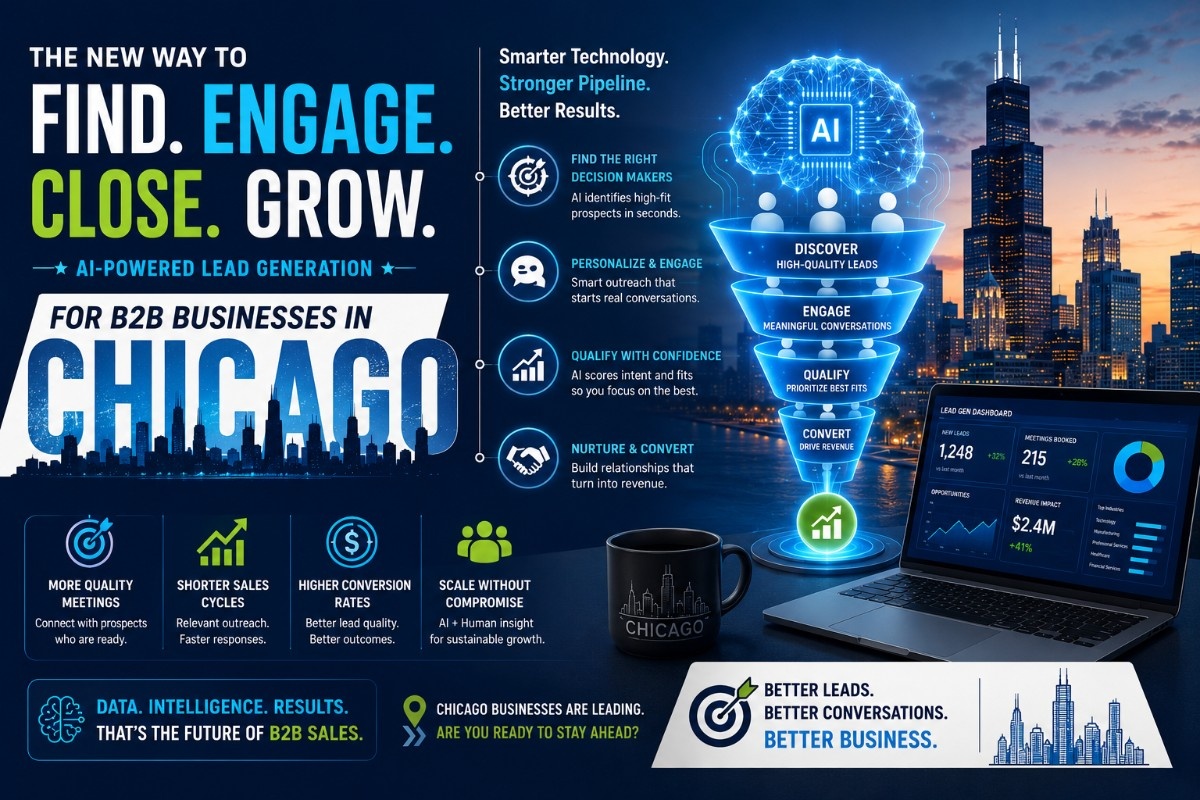
AI-powered lead generation in Chicago is transforming the process of qualifying prospects and closing deals for B2B firms through the use of predictive analytics, intent-based data and conversational AI agents, allowing for sales cycles shortened by weeks rather than days. By Gartner's forecast, 75% of all B2B firms will employ AI-powered selling techniques in the current year, and Chicago stands out due to its finance, logistics and SaaS sectors among the Midwestern markets.
Why Are Chicago Companies Switching to AI Lead Generation in 2026?
Chicago companies are switching to AI lead generation services because manual prospecting no longer keeps up with how buyers actually research, evaluate, and decide. Outbound dialing and static list pulls were already underperforming before the pandemic; in a city where the average enterprise buying committee now sits around 10 stakeholders, the old playbook simply runs out of runway.
There's a structural reason too. Forrester has long noted that B2B customers do well over half of their buying process, usually upwards of two-thirds, prior to contacting sales personnel. Once the Chicago SDR actually reaches someone by phone, the prospect will have done three competitor analyses, two analysts' reports, and one Reddit discussion thread. AI changes the entry point. It catches buyers earlier, often during research, when influence is still possible.
Then there's the cost pressure. As Salesforce’s State of Sales study finds, only 30% of time during the week is actually spent by the salesperson doing productive sales-related tasks while the rest 70% is spent on activities like administrative work, manual data entry, unproductive prospecting, etc. In Chicago’s constrained job market in 2026, spending $85K on a fully loaded BDR to manually crawl LinkedIn will no longer make sense from ROI perspective.
Local momentum matters as well. The 1871 ecosystem, the AI-focused startups clustered around Fulton Market, and the finance-tech overlap from CME-adjacent firms have created a referral loop. When one mid-market Chicago company sees a peer cut cost-per-lead by half, the calls start. That's how adoption actually spreads here — through proof, not pitch decks.
How Does AI B2B Lead Generation Work for Chicago Businesses?
AI B2B lead generation in Chicago works by pulling signals from dozens of sources — firmographic data, web behavior, hiring activity, technographic footprints, intent feeds — and using machine learning to rank which Chicago accounts are most likely to buy right now. The output isn't a list. It's a prioritized queue with reasoning attached.
A standard stack for a Chicago-based sales team in 2026 would be something along these lines. There is an ingestion layer that consumes data from various sources like Apollo, ZoomInfo, Cognism, 6sense, Bombora. There is a scoring layer, most commonly an advanced gradient boosted classification model but also, in some cases, a custom LLM-based one. There is an enrichment layer to fill in the blanks: additional people on the buying board, technologies they use, latest posts. Finally, an outreach layer — email sequencers, conversational AI chat, voice agents for outbound qualification — handles the first-touch volume.
McKinsey's research on generative AI in sales has consistently pointed to meaningful productivity gains where the technology is properly deployed, with the most cited range being a 3% to 15% revenue uplift and 10% to 20% ROI improvement in sales functions specifically. The Chicago firms hitting the upper end of that range aren't the ones that bought the most tools. They're the ones that connected their CRM data cleanly, trained the model on their actual closed-won deals, and gave their reps real workflow ownership.
A practical example: a Chicago logistics SaaS company I worked with last year was generating about 40 SQLs per month through cold outbound at a cost north of $400 per lead. After eight months of layered AI scoring, intent-triggered outreach, and an AI SDR handling first-reply qualification, they were pulling 110 SQLs at roughly $160 per lead. Nothing exotic in the stack. The difference was data hygiene and ruthless prioritization.
What Problems Does AI Solve in Traditional B2B Sales?
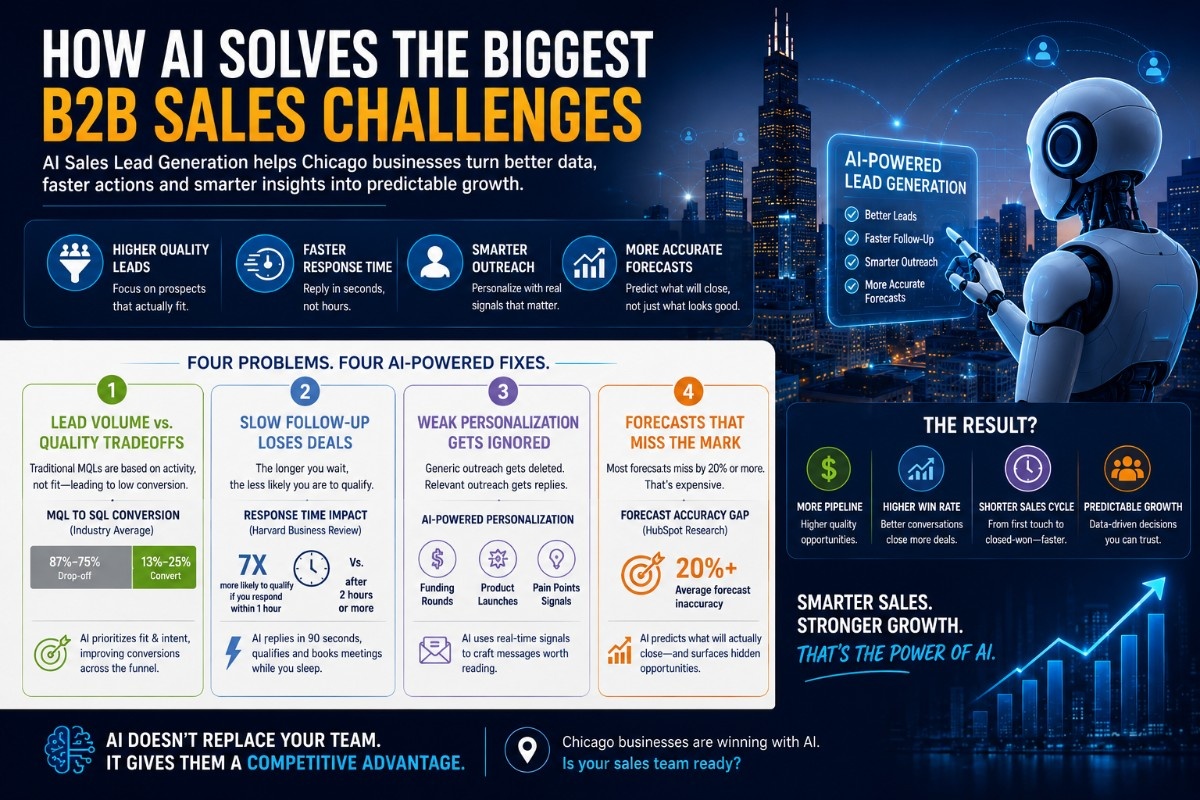
AI sales lead generation in Chicago solves four problems that traditional B2B has been stuck on for a decade: lead volume vs. quality tradeoffs, slow follow-up, weak personalization, and pipeline forecasting that's mostly fiction.
Lead quality is the obvious one. A typical Chicago marketing-qualified lead historically converted to a sales opportunity at single-digit rates — most studies put the MQL-to-SQL conversion somewhere between 13% and 25%, depending on industry. That gap exists because MQLs are defined by activity (downloaded an ebook) rather than fit (actually has budget and intent). Predictive AI scoring closes the gap by weighting fit signals more heavily, which is why teams using it tend to see conversion improvements that compound through the funnel.
Follow-up speed is the quiet killer. The classic Harvard Business Review study found that companies responding to inbound leads within an hour were seven times more likely to qualify the lead than those who waited even two hours. Most Chicago sales teams still respond in hours, sometimes days. AI doesn't get tired at 7 p.m. on a Friday. It replies in 90 seconds, qualifies, books the meeting, and lets the human walk into a warm conversation Monday morning.
Personalization is where AI separates the credible vendors from the noise. A generic "I noticed you're VP of Ops at email gets ignored in any Chicago inbox. An AI-drafted opener that references a recent funding round, a specific product launch, and a relevant operational pain — pulled from public signals — actually earns the read.
Forecasting is the fourth fix. HubSpot research has highlighted for years that the majority of sales forecasts miss meaningfully, often by 20% or more. Pattern-recognition models trained on a company's own deal history surface the deals that look like they'll close but won't — and the ones reps have written off that actually will. That's not magic. It's just better math applied to data sales leaders already had.
Which Industries in Chicago Are Using AI Lead Generation Most?
The heaviest AI lead generation adoption in Chicago sits in financial services, manufacturing and logistics, healthcare, professional services, and B2B SaaS. Each has a different reason for moving fast.
Financial services moved first, predictably. The proximity to CME, CBOE, and the cluster of fintech and wealth-management firms around the Loop means decision-makers are already comfortable with quantitative models. Predictive lead scoring is just another model. Statista has tracked global AI investment in financial services climbing into the tens of billions annually, and Chicago captures a real share of that spending.
Manufacturing and logistics — still a defining piece of Chicago's economy thanks to rail, the airport corridor, and the broader Midwest distribution role — adopted slower but more deeply. When the average deal is six figures and the sales cycle runs 9 to 14 months, even modest improvements in pipeline accuracy translate to millions. AI account-based marketing is now standard at most of the larger industrial firms headquartered between Schaumburg and Naperville.
Healthcare has been a more cautious adopter, mostly for compliance reasons. HIPAA constraints, BAA requirements, and procurement committees that include legal counsel all slow the buying cycle. But Chicago's hospital systems and the health-tech firms serving them have started using AI lead generation specifically for vendor and partner discovery, where the data is firmographic rather than patient-related.
Professional services — law firms, consultancies, accounting practices — were the surprise of 2025. The same firms that resisted any "marketing automation" for years quietly built AI-driven referral and account-targeting programs once they saw competitors winning RFPs they used to dominate.
While B2B SaaS may be the noisiest user segment, that doesn’t mean it’s the most advanced. In fact, many of the SaaS companies based out of West Loop and River North deploy the best-in-class AI technology early in the customer lifecycle but never incorporate the technology into their larger revenue engine.
Can AI Help Chicago Sales Teams Generate Better-Quality Leads?
Yes – AI does improve lead quality significantly and does so even more when the AI model is developed on actual company-specific closed/won and closed/lost data as opposed to relying on industry-wide data benchmarks.
The mechanism is straightforward. Traditional lead scoring weights surface behavior — opens, clicks, form fills. Predictive AI scoring weights fit and intent: company size, tech stack, hiring patterns, content consumption across the open web, executive movement. A Chicago marketing director who downloaded a whitepaper looks identical to a CFO with budget authority under behavioral scoring. Under predictive scoring, they look nothing alike.
Salesforce's research on AI-enabled sales teams has consistently found that high-performing reps are roughly twice as likely to be using AI as underperformers — which is correlation, not causation, but the directional signal is hard to ignore. In practice, the Chicago teams seeing the cleanest lift are the ones that ran a 90-day pilot, measured against a held-out control group, and refused to declare victory until the data was unambiguous.
One caution: lead quality only improves if the upstream data is clean. If a Chicago company's CRM is full of duplicate contacts, missing firmographic fields, and stage definitions that no two reps agree on, no model will rescue it. The unglamorous work of data hygiene is still the precondition. Anyone selling AI lead generation services in Chicago who skips that conversation is selling a feature, not an outcome — which is the kind of nuance worth pressing on when evaluating a partner like the team at Zebra Techies' AI lead marketing practice.
How Much Does AI Lead Generation Cost for Chicago Businesses?
AI lead generation costs for Chicago businesses in 2026 typically range from $2,500 to $15,000 per month for managed services, depending on the scope of the program, the size of the addressable market, and whether the engagement includes outbound execution or only data and scoring.
Pure software costs sit in a different bucket. A mid-market Chicago company running 6sense or Demandbase for intent data, a sales engagement platform like Outreach or Salesloft, and an enrichment layer like Apollo or Clay will spend anywhere from $40K to $250K annually on tooling alone, before the human team that operates it. Larger enterprises with custom-built models and full ABM motions can spend multiples of that.
The more useful number is cost-per-qualified-meeting. Manual outbound in Chicago — full-time SDR, tools, management overhead — usually lands somewhere between $400 and $900 per qualified meeting once everything is loaded in. Well-executed AI lead generation tends to bring that into the $150 to $350 range. The teams that don't see that improvement are usually paying for AI to send more email, not to think more carefully.
Worth saying directly: there's a tier of vendors selling "AI lead generation" in Chicago that is really just GPT-templated cold email at scale. It works briefly, until inbox providers catch up — which they did in 2024 with the Google and Yahoo bulk sender requirements, and have continued tightening since. Sustainable AI lead generation services in Chicago combine multi-channel orchestration, deliverability hygiene, and human-quality copy. The cheap stuff burns domains.
What Should Chicago Companies Look for in an AI Lead Generation Partner?
Chicago companies should look for an AI lead generation partner with verifiable case studies in their industry, transparent methodology, ownership of the underlying data and infrastructure, and a measurable framework tied to revenue rather than vanity metrics.
Five practical filters tend to separate the credible from the rest. First, ask how the model is trained — if the answer is vague or proprietary in a way that prevents you from understanding what signals matter, that's a red flag rather than a moat. Second, ask who owns the data and the CRM enrichment at the end of the contract; partners that hold your data hostage will cost you twice. Third, demand a defined attribution model before kickoff, not after. Fourth, ask for three references from clients of similar size in the Chicago or broader Midwest market. Fifth, walk away from anyone unwilling to commit to a 90-day measurable pilot.
Gartner's research on technology vendor selection has long emphasized that buyer regret in B2B software is highest when the buying group skips structured evaluation. The same applies here. The Chicago firms that get burned by AI lead generation services are usually the ones that bought on a demo and a discount.
What's Next for AI Lead Generation in Chicago Beyond 2026?
What's next is the shift from AI-assisted prospecting to fully autonomous revenue agents — software that doesn't just suggest the next action but executes it, end-to-end, with human approval at strategic checkpoints. The early versions are already running in Chicago pilots.
Three changes are coming faster than most teams expect. Voice AI for outbound qualification is improving past the uncanny-valley threshold; the 2026 versions can hold a real discovery conversation in ways the 2024 ones could not. Multi-agent systems — where a research agent, a writing agent, and a scheduling agent work together — are starting to replace the linear workflows of current sales engagement platforms. And the integration of first-party signal data, particularly from a company's own product usage and support history, is becoming the real competitive moat. Generic third-party data is becoming a commodity; what your own customers do is not.
The teams that will lead Chicago's B2B sales scene through the back half of the decade aren't the ones with the most AI tools. They're the ones treating AI as an operating model change rather than a tooling upgrade — rethinking territory design, comp plans, and the definition of a "good" lead from scratch. That mindset shift, more than any vendor selection, is what will define the next era of AI lead generation Chicago businesses can actually trust.
Frequently Asked Questions
- Is AI lead generation in Chicago worth the investment for small businesses? For small businesses with at least a defined ideal customer profile and a working CRM, yes — usually within 4 to 6 months. Companies without clean data or a defined sales process should fix those first, since AI amplifies whatever process exists, good or bad.
- How long does it take to see results from AI lead generation services in Chicago? Most well-run AI lead generation services in Chicago show measurable lift in qualified meeting volume within 60 to 90 days, with revenue impact typically visible in months 4 through 6, depending on the length of the sales cycle. Industries with longer cycles, like manufacturing and enterprise SaaS, take longer to show closed-won impact.
- Does AI lead generation replace human sales reps in Chicago B2B teams? No. AI replaces the repetitive, low-judgment portions of the role — list building, first-touch outreach, scheduling, data entry — and frees reps to focus on discovery, negotiation, and relationship work. The Chicago teams cutting headcount because of AI are usually the ones doing it badly.
- What's the difference between AI lead generation and marketing automation? Marketing automation executes pre-defined rules on known contacts; AI lead generation predicts which unknown accounts to target and which known contacts to prioritize, using signals beyond a company's own CRM. They complement each other rather than overlap.
- How does AI lead generation handle compliance with US data privacy laws? Reputable providers operate under CAN-SPAM for email, TCPA for voice and SMS, and increasingly under state-level privacy frameworks like the Illinois BIPA and consumer privacy laws emerging across other states. Any Chicago vendor that can't answer compliance questions in detail should be treated with caution.
- Can AI lead generation work for industries with long sales cycles, like Chicago manufacturing? Yes, and arguably better than for short-cycle industries. Long cycles produce richer signal data over time, which trains better models. The ROI just takes longer to surface in revenue, which is why account-based programs in Chicago manufacturing tend to be measured on pipeline coverage and stage progression rather than monthly closed-won.
- What metrics should Chicago sales leaders track to measure AI lead generation success? The short list: SQL-to-opportunity conversion rate, cost per qualified meeting, sales cycle length, win rate by source, and pipeline coverage by stage. Vanity metrics like email open rates or MQL volume should be tracked but never reported as success on their own.
- How is AI lead generation in Chicago different from other major US markets? Chicago's mix of legacy industrial buyers, financial services, and a growing tech cluster means programs have to handle longer cycles and more complex buying committees than in markets like San Francisco or Austin. So how does AI lead generation work in Chicago compared to coastal hubs? The successful local playbooks tend to be more patient, more ABM-leaning, and more reliant on multi-threading.
What's the Bottom Line on AI Lead Generation for Chicago in 2026?
The bottom line: AI lead generation Chicago companies adopt successfully comes down to discipline, not tools. The teams winning in 2026 have clean CRM data, a defined ICP, and the patience to measure a pilot honestly before scaling.
Two things matter most. Gartner's 75% AI-guided selling projection is already the floor for Chicago, not the ceiling — manual prospecting is now a liability in financial services, manufacturing, healthcare, and B2B SaaS. And the cost-per-qualified-meeting math is decisive: well-run programs roughly halve acquisition costs.
For Chicago B2B teams evaluating credible AI lead generation services in Chicago, the practical move is a structured 90-day pilot tied to revenue metrics before any longer commitment. Reviewing a partner's approach to AI lead marketing in Chicago is a reasonable place to start.

By Professional qualification a Computer Engineer, By Profession an Online Marketing Strategist and Web Application Development Expert, By Industry position working as a CEO at Zebra Techies Solution!