



How AI Property Search Is Changing Buyer Discovery for Hudson Yards Real Estate Businesses in 2026
The 2026 question every Hudson Yards principal should be asking
A two-bedroom condo at 35 Hudson Yards and a 25,000-square-foot office floor at 50 Hudson Yards are sold through almost entirely different processes — but in 2026 they share the same first step: a
prospective buyer, tenant, or corporate real estate lead now frequently opens a conversation with an AI system before they open a listing portal. The executive question this raises isn't "should we do
SEO," it's narrower and more urgent: when a buyer's first move is a prompt instead of a search, does our firm exist in the answer — and can we still convert what reaches us?
That question matters more in Hudson Yards than almost anywhere else in Manhattan. The district's Q2 2026 median home sale price sat at roughly $5.5 million, down 8% year-over-year, with median price per square foot at about $2,107, down 10% year-over-year (PropertyShark, Q2 2026 market data). On the commercial side, the neighborhood is still absorbing momentum from Deloitte's record 807,000-square-foot, roughly $2.6 billion lease at 70 Hudson Yards — the priciest Manhattan office deal since the pandemic (CRE Daily/Bisnow, 2025) — alongside anchor tenants like BlackRock,
Related Companies, SAP and Wells Fargo. High price points and long, high-stakes decision cycles
are exactly the conditions in which buyers now lean on AI to pre-filter before they ever call an agent.
The exposure paradox: real estate looks "safe," but the discovery layer has already moved
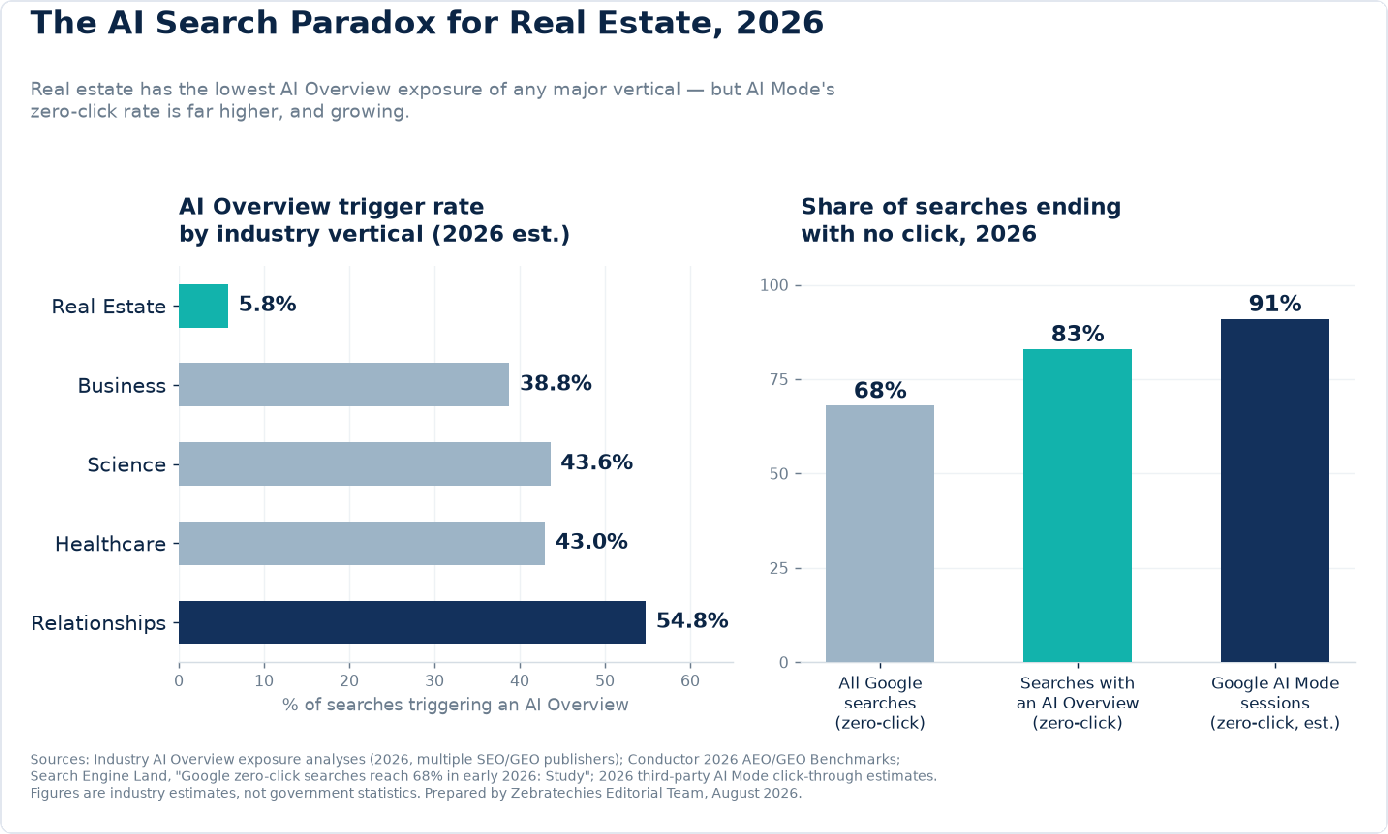
Industry analyses of Google's AI Overviews across verticals consistently find real estate near the bottom of AI Overview trigger rates — commonly cited in the 4.5%–5.8% range, the lowest of any major consumer category, with roughly a 26-percentage-point gap between the highest-exposure vertical (communication services) and real estate (Conductor 2026 AEO/GEO Benchmarks; industry AI Overview exposure analyses, 2026). The reasoning is straightforward: Google still routes transactional, location-specific queries — "condos for sale Hudson Yards," "office space 10 Hudson Yards" — toward maps, listings, and inventory data that a generative summary can't fully replace.
That statistic has led some brokerage leaders to conclude AI search isn't yet a priority. It's the wrong read. AI Overviews are only one surface. Google's separate AI Mode — its fully conversational search experience — passed 1 billion monthly users in 2026 (per Google's own 2026 product updates, widely reported across the search-marketing press), and third-party click-through research published in 2026 estimates that a large majority of AI Mode sessions — often cited near 90%+ — end without a click to any external website at all. Separately, broader zero-click research found that 68% of all
Google searches ended without a click in early 2026, rising to 83% when an AI Overview specifically
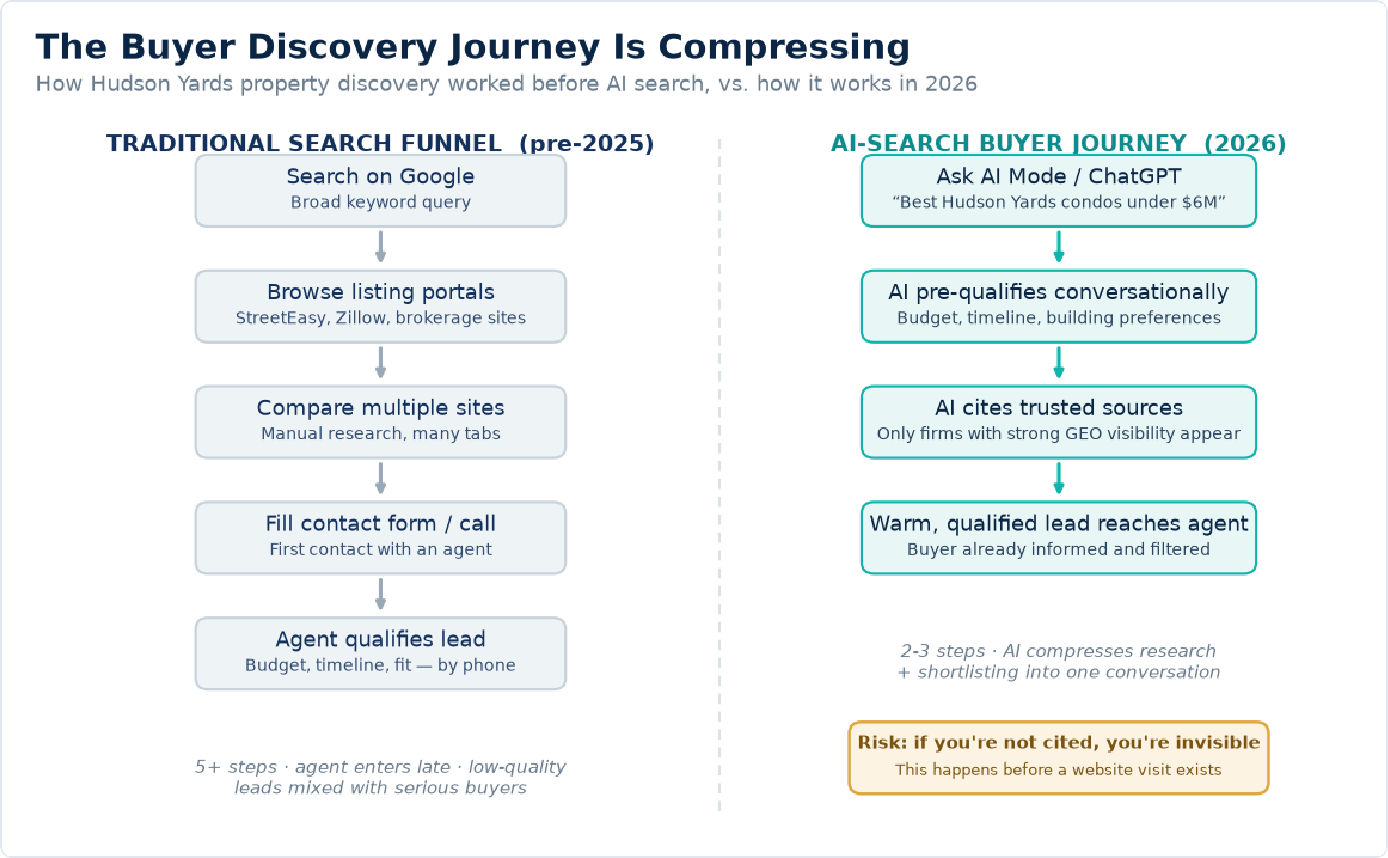
appeared (Search Engine Land, 2026 study). Real estate's low Overview exposure says nothing about its AI Mode exposure — and AI Mode is where a buyer can now ask "which Hudson Yards buildings have the best amenities under $6M" and receive agent, brokerage, and building recommendations conversationally, without a single visit to a firm's website.
From portal volume to AI-qualified intent
The more consequential 2026 shift for Hudson Yards firms isn't traffic — it's lead composition. One 2026 industry lead-performance analysis comparing AI-sourced leads against traditional portal leads found AI-sourced leads closing at roughly 9.6% within 90 days versus about 2.4% for portal-sourced leads, with meaningfully higher average commission value per lead and a shorter time-to-close.
Directionally, this tracks with what AI chat interfaces are built to do before handoff: qualify budget, timeline, unit size, and building preference conversationally, then route only the serious prospect to a human. For a Hudson Yards brokerage handling $4–15 million condo transactions or corporate office searches with multi-year lease terms, that pre-qualification step is the difference between an agent's day being spent on discovery calls versus closing calls. This is a genuine 2026 opportunity — but it
should be read as an early, evolving pattern from one industry data set, not an industry-wide guarantee.
The competitive risk: citation share is concentrating fast
Perhaps the sharpest executive risk is concentration. One 2026 analysis of AI citation patterns among
U.S. real estate agents found only a small single-digit percentage of agents appearing in AI-generated search responses at all, with a disproportionate share of that visibility captured by a small top tier of
firms per metro. Whether or not the exact figures hold precisely at the Hudson Yards submarket level, the mechanism is well understood and consistent with how generative engines work generally: AI
systems tend to cite a narrow set of sources repeatedly rather than surfacing the long tail the way traditional search results once did. In a submarket as concentrated and high-value as Hudson Yards — a handful of towers, a handful of dominant brokerages, a handful of active developers — being one of the sources an AI system trusts and cites is closer to winning a duopoly position than ranking on page one of Google once was
How will this affect revenue and agent productivity?
Three concrete mechanisms connect this shift to the P&L. First, enquiry quality over enquiry volume: fewer, better-qualified conversations reduce wasted agent hours on unqualified showings — directly improving revenue per agent. Second, citation concentration creates a winner-take-most dynamic in visibility: firms absent from AI answers risk a widening gap versus the small set of competitors AI
systems already trust, independent of how good their listings or service actually are. Third, the operational requirement is different from classic SEO — it means structuring listing data, building profiles, and firm expertise in ways generative engines can parse and cite (schema markup, clear factual building/unit data, authoritative long-form content), not just chasing keyword rankings. Firms that treat this as a technology and content-operations problem, not a paid-media problem, are the ones positioning for the shift rather than reacting to it after competitors gain ground.
Executive takeaway: Low AI Overview exposure is not the same as low AI-search risk. For Hudson Yards firms, the real exposure is in AI Mode and conversational search — surfaces that don't show up in traditional "AI Overview" exposure reports at all.
What should business leaders do next
-
Audit AI visibility now, not later. Ask ChatGPT, Gemini, and Google AI Mode a buyer's actual Hudson Yards questions and see who gets cited. Treat any gap as a competitive risk, not a marketing footnote.
-
Restructure listing and building content for machine readability. Structured data, clear factual specs, and authoritative building/neighborhood guides are what generative engines pull from — thin listing pages are not.
-
Re-tool intake, not just marketing. If AI-originated enquiries arrive pre-qualified, agent
workflows and CRM routing need to change to capture that advantage rather than treating every lead identically.
-
Track citation share as a KPI, alongside traditional lead volume and conversion — it is the leading indicator of AI-search competitive position in a concentrated submarket like Hudson Yards.
-
Get outside support if this isn't a core internal competency. Firms without dedicated technical SEO/GEO resources are increasingly working with specialist partners — for Hudson Yards-focused brokerages, Zebratechies' AI lead marketing services for Hudson Yards is one option built specifically around this district's buyer and tenant discovery patterns.
The firms that treat 2026's AI search shift as a structural change to how buyer intent forms — rather than a traffic dip to wait out — are the ones most likely to still be the cited, trusted answer when a Hudson Yards buyer's next question goes to an AI system instead of a search bar.

By Professional qualification a Computer Engineer, By Profession an Online Marketing Strategist and Web Application Development Expert, By Industry position working as a CEO at Zebra Techies Solution!