



How AI Search Is Rewriting Property Discovery in Hudson Yards Real Estate, 2026
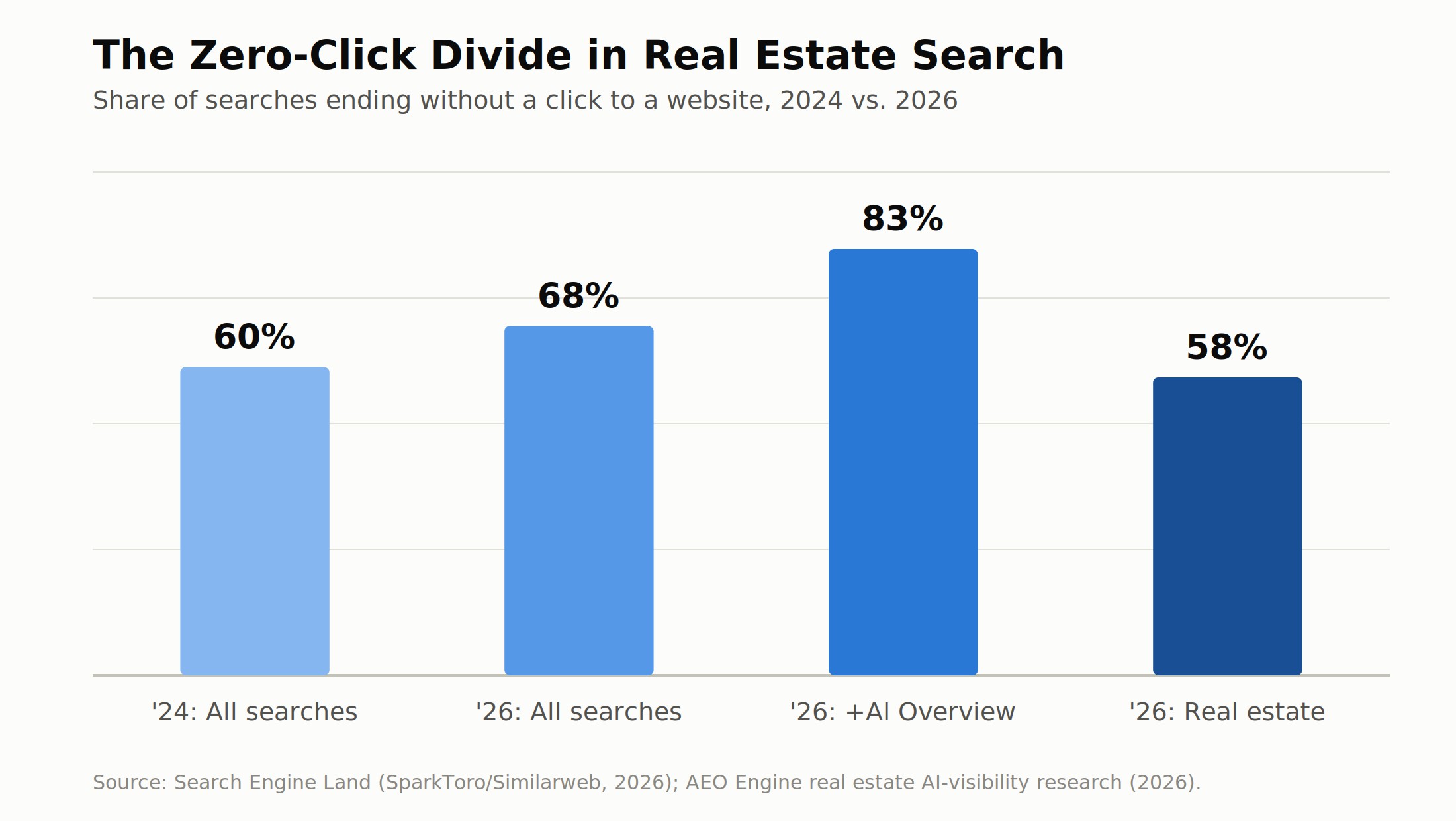
When 68% of U.S. Google searches now end without a click — and 83% do when an AI Overview appears — the real estate businesses competing for Hudson Yards' $153-per-square-foot office towers and $4.75 million median condos are fighting for visibility inside an answer, not a results page. For CEOs and brokerage principals, that is no longer a marketing footnote; it is a distribution problem with revenue attached.
What Changed in 2026
For most of the last two decades, property discovery followed a predictable path: a buyer or tenant typed a query into Google, scanned ten blue links, clicked through to a listing portal or brokerage site, and a lead form or phone call followed. That path is now the exception rather than the rule. A SparkToro analysis of Similarweb data found that 68% of U.S. Google searches resolved without any click to an external site in early 2026, up from roughly 60% in 2024 — and when Google's AI Overview panel appears above the results, the no-click rate jumps to 83%, according to the same study reported by Search Engine Land.
Real estate has not been immune, but it has been unevenly exposed. Industry analysis from AEO Engine notes real estate sits among the lower-exposure categories for AI Overview takeover, because Google still leans on Maps, MLS inventory feeds and Business Profile data that generative summaries can't fully replicate — yet the same research found 58% of property searches now surface an AI-generated answer before a user ever reaches a listing page. In practical terms: the query still gets answered, it just may not send the searcher anywhere near your website.
Layered on top of that shift is the arrival of AI as a search destination in its own right. Zillow's new AI Mode, described by the company as a conversational experience that helps buyers "discover homes through conversation" and "remember preferences across sessions" (Zillow Front Porch), now sits alongside a Zillow app inside ChatGPT that surfaces listings, photos and pricing directly in the chat window. Realtor.com followed with its own ChatGPT search integration in March 2026, explicitly positioning it to keep MLS data and agents "central to the conversation" (Real Estate News). Buyers are no longer just Googling a neighborhood — they are asking a chatbot to shortlist it for them, and the chatbot is increasingly answering from a portal's data, not an individual firm's.
Why This Matters Specifically for Hudson Yards
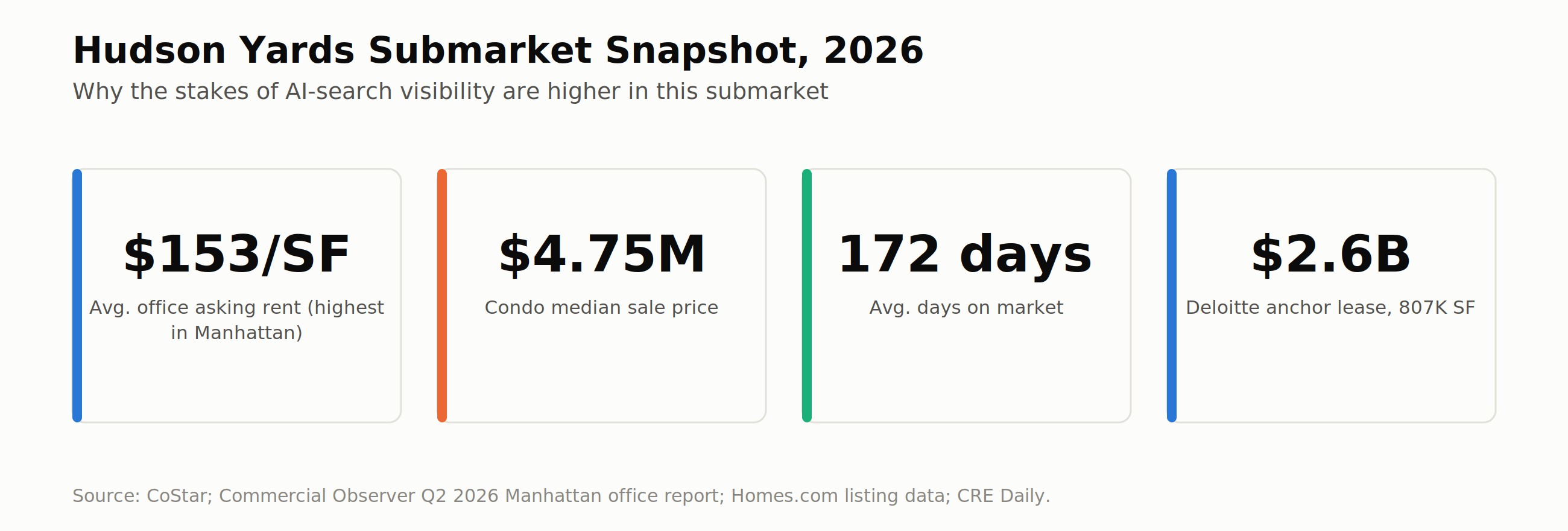
Hudson Yards is not an average submarket, and that is precisely why the AI-search shift carries outsized executive risk here. On the commercial side, the district enters the second half of 2026 functionally full: Related Companies' CEO has described the original Hudson Yards office towers as fully occupied, and asking rents have climbed to an average of $153 per square foot, the highest of any Manhattan submarket, with select towers clearing $200–$250/SF (CoStar; Commercial Observer). Deloitte's roughly $2.6 billion, 807,000-square-foot commitment at 70 Hudson Yards — the priciest Manhattan office lease since the pandemic — underscores that the tenants still active in this submarket are large, sophisticated, and doing extensive digital diligence long before a broker ever gets a call (CRE Daily).
On the residential side, Hudson Yards condos currently list from roughly $1.29 million to $22.95 million, with a median sale price near $4.75 million and an average of 172 days on market, per listing-aggregator data compiled by Homes.com. That is a slow-moving, high-consideration purchase cycle — exactly the kind of decision buyers now research through extended AI conversations rather than a single search session. A prospective buyer comparing 15 Hudson Yards against Manhattan West or the Plaza District is, in 2026, plausibly doing that comparison inside Zillow's AI Mode or a ChatGPT thread, weighing amenities, price per square foot and commute logic before a single agent is contacted.
Combine a fully leased, ultra-premium commercial submarket with a slow-absorption, high-ticket residential one, and you get a market where enquiry volume was already scarce and highly qualified. When the discovery layer shifts to AI answers pulled from portals and Business Profiles rather than a
firm's own site, the risk is not losing casual traffic — Hudson Yards firms never had much of that to lose. The risk is losing visibility in the handful of high-intent conversations that actually convert into a signed lease or a closed sale.
The Buyer and Tenant Behavior Shift
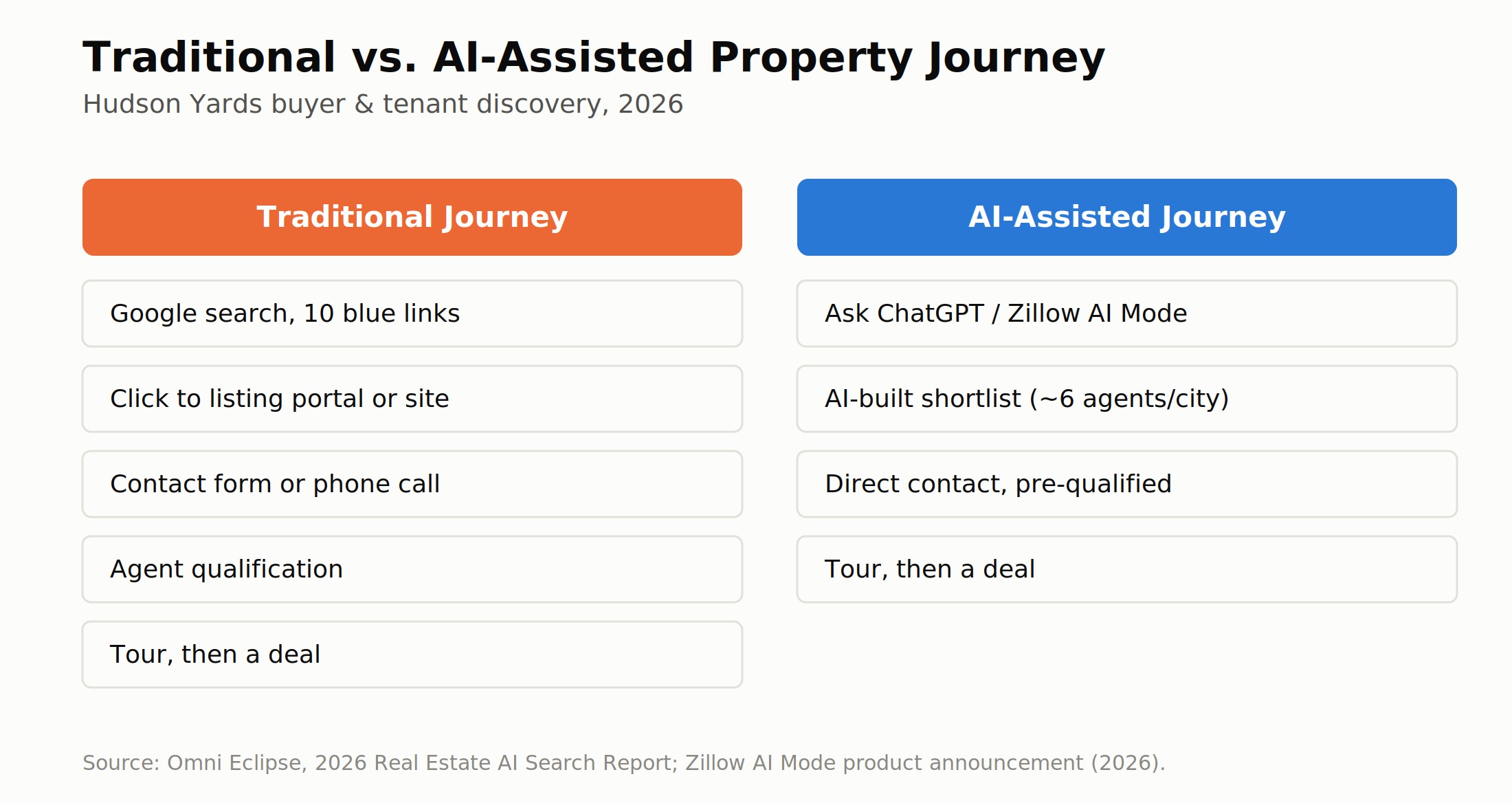
The behavioral change is best understood as a shift from search-and-click to ask-and-shortlist. Buyers and corporate real estate teams increasingly open a conversational tool, describe their requirement in natural language — floor plate size, target rent, proximity to transit, amenity mix, timeline — and receive a synthesized shortlist, often with a named agent or two attached. Research cited by Omni Eclipse found that ChatGPT names a median of just six agents per city when asked who to work with in a given market, and that 98% of what it cites back to justify those recommendations traces to the agent's own website and Google Business Profile. That is a strikingly narrow funnel: in any given city, the AI layer is not surfacing hundreds of competitors — it is surfacing a shortlist, and deciding who's on it based on structured, verifiable, third-party-corroborated content that most brokerage marketing was never built to produce.
On the commercial side, the same logic is playing out earlier in the pipeline. Platforms are now using AI to ingest CoStar records, Reonomy data, public filings and news to rank tenants likely to be
in-market within 12–18 months, and lease-abstraction tools such as VTS's Asset Intelligence (shipped April 2026) are pulling qualification and covenant analysis directly into the leasing workflow brokers already use, according to GrowthFactor's 2026 CRE AI guide. Tenant prospecting itself is becoming an AI-mediated activity before a broker's outreach ever begins.
The commercial consequence for lead quality is double-edged. Early data referenced in real estate GEO research — including analysis from P11 — suggests visits referred from AI/LLM sources convert to meaningful engagement at multiples of the rate typical search traffic does, because the searcher arrives already qualified by the AI's own filtering. Fewer leads, but sharper ones, is the pattern executives should plan around — not fewer leads and the same funnel.
The Executive Risk and Opportunity
For Hudson Yards leadership teams, three risks compound if this shift is left to the marketing team's backlog rather than treated as a board-level distribution issue:
-
Disintermediation risk. If AI answer engines default to citing large national portals (Zillow,
Realtor.com, CoStar) rather than an independent brokerage's own site, firms that have
under-invested in structured, citable content risk becoming invisible in the exact moment a buyer or tenant is forming a shortlist — regardless of how strong their actual inventory or track record is.
-
Narrow-shortlist risk. With AI tools naming a median of six agents per city, the competitive set for "being the cited answer" in a submarket as concentrated as Hudson Yards is small and largely first-mover. Firms that wait 12–24 months to address answer-engine visibility may find the shortlist already set by faster-moving competitors.
-
Attribution and pipeline-measurement risk. Zero-click and AI-mediated discovery breaks traditional last-click attribution. Marketing and sales leadership that still measure success purely by website sessions or portal-form submissions will under-report the AI layer's real influence on enquiry generation — and misallocate budget away from the channels actually shaping decisions.
The opportunity mirrors the risk. Structured, accurate, consistently published information — correct Business Profile data, verifiable transaction history, clear Q&A-style; content answering the exact questions buyers and tenants ask AI tools, and third-party proof points such as press coverage and reviews — is precisely what AI systems reward with citations, per guidance from HousingWire's answer-engine-optimization coverage. In a submarket as data-rich and high-value as Hudson Yards, the firms that formalize this now gain a compounding visibility advantage that is expensive for later entrants to close.
What Business Leaders Should Do Next
Over the next 12–24 months, Hudson Yards real estate leadership should prioritize four moves:
-
Audit AI visibility, not just search rankings. Query the major AI tools — Google AI Overviews, ChatGPT, Perplexity, Gemini — with the exact questions your buyers and tenants ask, and document whether your firm, listings, and named agents appear. Treat gaps as a pipeline risk, not a curiosity.
-
Invest in answer-engine-ready content and data hygiene. Standardize Business Profile, MLS/CoStar listing data, and website content so they say the same thing everywhere, in a format (clear headings, direct Q&A;, verifiable stats) generative engines can lift cleanly and confidently attribute.
-
Re-architect lead qualification and CRM around AI-referred enquiries. Because AI-referred leads arrive pre-filtered, agent teams should be trained and resourced to convert a smaller, hotter pipeline rather than a larger, colder one — enquiry conversion and agent productivity per lead, not raw volume, become the metrics that matter.
-
Build measurement that accounts for zero-click influence. Layer brand-search lift,
direct-to-agent contact, and AI-referral tracking alongside traditional analytics so leadership can see the full effect of the AI layer on absorption and lead generation, not just the shrinking slice that still shows up as a website click.
Firms that treat this as a technical SEO update rather than a strategic distribution shift will spend the next two years losing ground quietly. This is a market-share fight for where AI decides to point the smallest, best submarket in Manhattan.
Zebratechies' AI Lead Marketing service for Hudson Yards was built for exactly this transition — helping brokerages and property owners in the submarket structure their listings, profiles and content so AI search engines cite them, rather than a national portal, when a buyer or tenant asks the question that matters.

By Professional qualification a Computer Engineer, By Profession an Online Marketing Strategist and Web Application Development Expert, By Industry position working as a CEO at Zebra Techies Solution!