



SEO Playfield is Widening - How Well are You Ready?
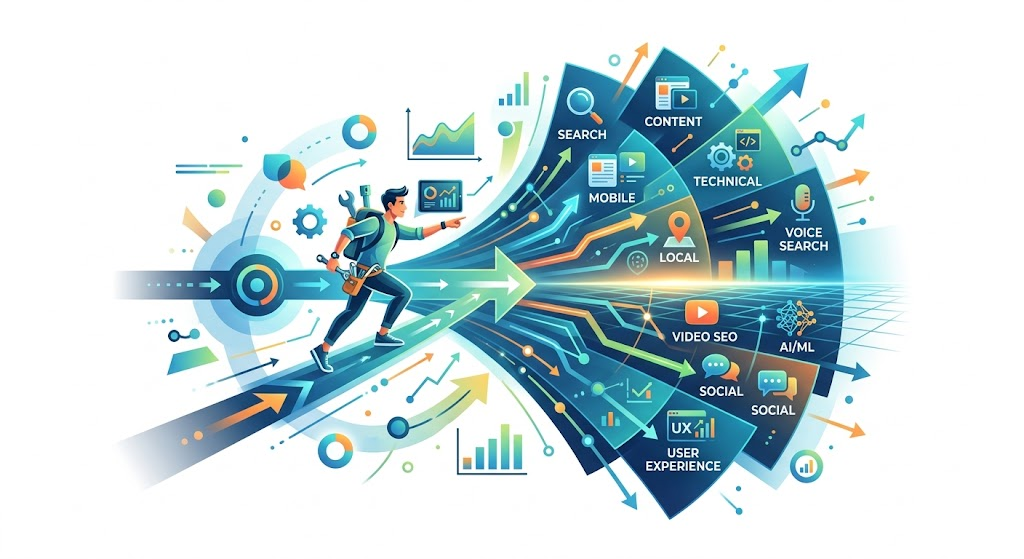
Remember when getting to Page 1 of Google felt like the finish line? Well, that was a different era. Today, the search landscape has stretched into something far larger, layered, and honestly, a lot more exciting. The rules have changed, and if your SEO strategy still looks the same as it did two or three years ago, you might be competing on a field that no longer exists.
Let's talk about what's actually happening, why it matters for your business, and what you need to do before you fall behind.
Wait, Isn't SEO Just About Rankings Anymore?
Short answer: no. And the longer answer is worth reading.
Search visibility is no longer one layer. It is a stack. Ranking is just the entry point. What sits on top of that - AI citations, structured data, agent-usability - is where the real competitive ground is forming in 2026.
There are now three distinct layers every serious digital presence needs to consider:
Traditional SEO is the foundation. It gets your brand found in search results. Without this working properly, nothing else functions.
AI Visibility sits on top of that. It is about getting mentioned and cited in AI-generated answers, whether that's Google's AI Overviews, ChatGPT Search, Perplexity, or Claude. Citations create visibility. Strong SEO builds authority and clear entity signals. This earns AI mentions. Practices like generative engine optimization (GEO) and answer engine optimization (AEO) sit squarely in this layer, helping your content show up as a trusted source inside AI-synthesised responses, not just as a blue link.
AI Readiness is the third layer, and the newest one most businesses haven't even begun thinking about. It is about getting used by AI agents to complete tasks on your website. Think of a user asking an AI assistant to "find me a web development company in India and book a consultation." For that to work, your website needs to be executable, not just readable.
Before going deeper, let's know what those three layers are!
AI Readiness is the first layer. What is AI Readiness? It is like getting used by AI agents to complete tasks on your website. Then comes AI Visibility. AI Visibility is about getting mentioned and cited in AI-generated answers, while traditional SEO, which is one of the most important layers, would help a brand get found in search results, which is the foundation everything builds on.
All three layers build on the last. You can't be agent-ready without strong SEO foundations. But stopping at traditional SEO in 2026 means you're only one-third of the way there.
Key Takeaway: SEO is now a three-layer stack, traditional search, AI visibility, and AI agent readiness. Miss any layer and you leave the table half-set.
What Is Happening to Google's Ranking System Right Now?
Something significant has been unfolding quietly. Google's ranking systems have historically evaluated only 20 to 30 candidate pages through their most sophisticated deep-learning components before finalising results. This wasn't a design choice born of precision, it was a hardware constraint. Deep evaluation is expensive.
But here's where things get interesting. Google Research published a vector compression technique in early 2026 that reduces memory costs dramatically, making it computationally viable to evaluate a far larger pool of pages. If — and this is a meaningful "if" this reaches Google's live search infrastructure, the competitive window widens significantly.
What does that mean practically? Pages that were previously never in contention might suddenly enter the evaluation set. Content that was always strong but never "seen" could get its moment. And content that was ranking purely on legacy signals without genuine quality might lose ground to fresher, better-structured competitors.
A Gartner prediction already flagged that traditional search volume will drop 25% by 2026, with search losing share to AI chatbots and virtual agents. The trajectory is confirmed. The shift isn't confirmed in production yet, but the direction is clear and the technology is already published.
Key Takeaway: The candidate pool for Google ranking may widen considerably. This rewards content quality and penalises content that coasted on older signals alone. Content built around long-tail keywords and genuine topical depth is better positioned for this shift than broad, shallow pages.
What Is WebMCP and Why Should Web Teams Care?
WebMCP signals the shift from pages built to be read to systems built to be executed. This is not theoretical. AI visibility is already measurable, and AI agent usability is becoming measurable too.
When AI assistants browse the web autonomously, they don't experience a page the way a human does. They look for structured, machine-readable content — clear headings, unambiguous data, defined entities, and accessible actions. A beautifully designed website that isn't structured for machine interpretation is essentially invisible to this new layer of traffic.
This is exactly where structured data SEO and schema markup for websites come into play. Schema tells machines what your content means, not just what it says. An FAQ schema, an organisation schema, a service schema, each of these is a signal that AI crawlers and Google's ranking systems can act on directly. Without them, even excellent content can go unacknowledged in AI-generated answers.
This is exactly why at ZTS Infotech Pvt. Ltd., the approach to web design and development has evolved beyond aesthetics and traditional SEO friendliness. The focus now is on building websites and mobile apps that are structured for both human users and AI systems, because that combination is what drives outcomes in the current environment.
Agent usability drives outcomes. That's not a future prediction. It's already happening.
Key Takeaway: If your website can't be "used" by an AI agent, you're missing an emerging traffic and conversion layer entirely. Add schema markup, clean up your structured data, and structure for machines, not just for readers.
Is My Business Actually Prepared? A Quick Gut Check
Here are the questions worth asking yourself honestly right now:
Does your content answer questions directly, or does it bury the answer in preamble? AI systems extract and cite claims. If your key insight lives in paragraph seven after three paragraphs of context-setting, it won't get cited. The claim needs to be front and centre, this is the core principle behind answer engine optimization (AEO).
Does your site have clean structured data and schema markup? This is no longer optional for businesses serious about AI search visibility. Schema tells machines what your content represents, not just what it says. A 2026 survey by Goodfirms found that only 14% of marketers currently track AI citation visibility, meaning most businesses are flying blind on the fastest-growing search surface. Setting up even basic monitoring now puts you ahead of 86% of your competitors.
Are AI crawlers actually visiting your pages? This is checkable through server logs. Crawlers like OAI-SearchBot, PerplexityBot, and Claude-SearchBot don't show up in standard analytics because they don't execute JavaScript. AI crawlers website optimisation starts with making sure these bots can reach, read, and index your important pages. If they aren't visiting, those pages simply don't exist in AI-generated answers.
Is your site fast, mobile-optimised, and technically clean? The SEO fundamentals haven't disappeared, they've become the prerequisite for everything else. A slow, crawlable-but-messy site fails at the foundation layer. Running a thorough website SEO audit in 2026 means checking technical health and AI accessibility, not just page speed and meta tags.
Are you targeting the right keywords? High-competition, broad keywords are increasingly being absorbed by zero-click search results and AI Overviews before a user ever clicks. Nearly 80% of keywords that trigger Google AI Overviews fall into the 0–40% difficulty range. A smart long-tail keywords SEO strategy, focused on specific, intent-driven queries, gets your content cited inside AI answers rather than buried beneath them.
If any of those answers made you uncomfortable, that's actually useful information.
Key Takeaway: AI visibility is already measurable. Check your server logs. If AI crawlers aren't visiting your key pages, no amount of keyword optimisation will fix that gap.
How Does the AI + Human Collaboration Fit Into This?
Here's a perspective that often gets lost in the noise of "AI is changing everything" headlines: the businesses that will win this new search landscape aren't the ones who hand everything to AI tools, nor the ones who stubbornly ignore them. It's the ones who use AI to accelerate human creativity and judgment.
At Zebra Techies Solution, the working model is built on exactly this, a collaborative approach between human designers and developers and AI. The combination of AI and human intelligence isn't about replacing skilled people. It's about compressing timelines, eliminating repetitive bottlenecks, and freeing up human minds to focus on the strategy and creative decisions that actually move the needle.
When a web development project comes in, AI assists with structural analysis, SEO audits, schema generation, AI Overviews optimisation, and performance profiling, tasks that used to eat days. Human designers and developers then take that foundation and build experiences that are intuitive, branded, and genuinely useful. The same collaborative approach applies to mobile app development, apps are now built with AI-readiness baked in, not bolted on afterwards.
The result: faster delivery, higher quality, and digital products that are ready for both human users and AI systems. For businesses searching for a reliable web development company in India that understands both the technical and strategic dimensions of modern SEO, this AI + HI model is what separates surface-level work from outcomes that last.
This isn't theoretical. It's the working approach, and it shows in outcomes.
Key Takeaway: AI + Human Intelligence is not a buzzword. It's a production model that delivers faster, smarter, and more search-ready digital products than either working alone.
So What Should You Actually Do Next?
The good news: this doesn't require rebuilding everything overnight. It requires knowing what layer you're on right now and what the next step looks like.
Start with your SEO foundation. Technical health, site speed, mobile experience, clean crawlability, these remain essential and they're the prerequisite for everything above. A proper website SEO audit surfaces the gaps that are quietly holding back both traditional rankings and AI visibility.
Then look at your content structure. Are your pages answering specific questions clearly and directly? Are entities named and defined? Is your most important information accessible within the first hundred words of a page rather than buried? This is the basis of solid AEO and GEO practice, not a separate strategy but a smarter version of what good content has always tried to do.
Then consider schema and structured data. If your pages don't have appropriate schema markup, adding it is one of the higher-leverage moves available right now. It signals to AI systems what your content represents and makes it far easier to cite.
Develop a long-tail keyword strategy. Broad, high-competition terms are increasingly captured by AI Overviews before a user ever clicks. Long-tail, conversational, intent-driven queries are where organic traffic and AI citations converge, and where focused businesses can genuinely outperform larger, slower-moving competitors.
Finally, check your AI crawl logs. If the relevant AI crawlers aren't visiting your site, that's a technical accessibility issue, not a content problem, and it needs fixing at the infrastructure level.
If this feels like a lot to audit at once, that's fair. A professional digital strategy and web development team can run that audit in hours, not weeks.
One More Thing Worth Saying Directly
The businesses that thrive in the next two to three years won't be the ones who wait to see how this shakes out in their analytics. By then, competitors will have already established authority in AI-generated answers, structured their content for agent usability, and built the kind of digital presence that earns citations, not just clicks.
The SEO playfield is genuinely widening. More pages are entering contention. AI is generating answers that bypass traditional rankings entirely. Agents are completing tasks on behalf of users.
You can be the business that shows up at every layer of that stack, or you can be the one wondering why organic traffic feels less reliable every quarter.
ZTS Infotech Pvt. Ltd. helps businesses build websites, mobile apps, and digital strategies that are designed for this exact moment, combining the speed and precision of AI with the insight and craftsmanship of experienced human designers and developers. If your digital presence needs to catch up with where search is actually going, that conversation starts here.
Search visibility is no longer a single channel. Build for the full stack, or watch the field widen without you.
Frequently Asked Questions (FAQs)
Q1. What is the difference between SEO, GEO, and AEO and do I need all three?
Yes, and here is why they are distinct but connected. Traditional SEO helps your pages appear in search engine results like Google. GEO (Generative Engine Optimization) focuses on getting your content cited inside AI-generated answers from tools like ChatGPT, Perplexity, and Google AI Overviews. AEO (Answer Engine Optimization) is about structuring your content to directly and clearly answer specific user questions, making it easier for both search engines and AI systems to extract and display your response. They are not competing strategies, they build on each other. Without strong SEO, neither GEO nor AEO can work effectively. Think of them as floors in the same building, not buildings in different cities.
Q2. How do I know if AI crawlers are visiting my website?
Check your server logs, not your Google Analytics. AI crawlers like OAI-SearchBot (ChatGPT), PerplexityBot, and Claude-SearchBot do not execute JavaScript, which means they are completely invisible to standard analytics tools. Log into your server access logs and filter for these specific user agents. If you see zero activity from them on your key pages, those pages are not being considered for AI-generated answers, regardless of how well they rank on Google. Fixing this is a technical accessibility issue that a capable website development partner can resolve at the infrastructure level.
Q3. What is schema markup and why does it matter for AI search visibility?
Schema markup is structured data code that you add to your web pages to help search engines and AI systems understand what the content means, not just what it says. For example, a schema for a service page tells AI systems: this is a business, this is what they offer, this is their location, this is how to contact them. Without schema, AI systems have to guess, and they may guess wrong, skip your page, or cite a competitor instead. Schema markup is one of the highest-leverage, lowest-cost improvements you can make to a website right now, and it directly improves your chances of appearing in Google AI Overviews, featured snippets, and People Also Ask results.
Q4. Is traditional SEO still worth investing in, or should I shift entirely to AI optimisation?
Traditional SEO is still absolutely essential, it is the foundation that all other layers depend on. You cannot be visible in AI-generated answers if you do not have basic technical SEO health, crawlability, and domain authority working in your favour. What has changed is that SEO alone is no longer enough. Think of it as a three-floor building: traditional SEO is the ground floor and the structural load-bearing core. AI visibility through GEO and AEO is the first floor. AI agent readiness is the top floor. You cannot skip to the top floor without building from the ground up, but you also cannot stop at the ground floor and call the building complete.
Q5. How does a long-tail keyword strategy help with AI search in 2026?
Long-tail keywords, specific, multi-word, conversational search phrases, align naturally with how AI search systems work. Nearly 80% of keywords that trigger Google AI Overviews fall in the low-difficulty range, meaning AI summaries most often appear on specific, informational queries rather than broad, high-competition terms. When you target precise questions your audience is actually asking (for example, "how to choose a mobile app development company in India" rather than just "app development"), your content has a far better chance of being the source an AI system cites in its answer. It also converts better because the user intent is clearer and more specific, and that combination of visibility and conversion is exactly what a well-executed long-tail strategy delivers.
Q6. How does ZTS Infotech help businesses improve their SEO and AI search readiness?
At ZTS Infotech Pvt. Ltd. (Zebra Techies Solution), the approach combines human expertise with AI-assisted tools to audit, build, and optimize digital products for where search is actually heading. This includes technical SEO audits, schema markup implementation, structured data optimisation, AI crawl accessibility reviews, and web development and mobile app development that is built to be readable by both humans and machines. The team operates on an AI + Human Intelligence model, AI handles the analytical and repetitive groundwork, while experienced designers and developers focus on strategy, user experience, and execution quality. The result is faster project turnaround, better search performance, and digital assets that are genuinely ready for the multi-layer SEO environment of 2026 and beyond.

By Professional qualification a Computer Engineer, By Profession an Online Marketing Strategist and Web Application Development Expert, By Industry position working as a CEO at Zebra Techies Solution!