



Silicon Valley 2026: Why Human Marketers Are Now Managing AI Agents Instead of Campaigns
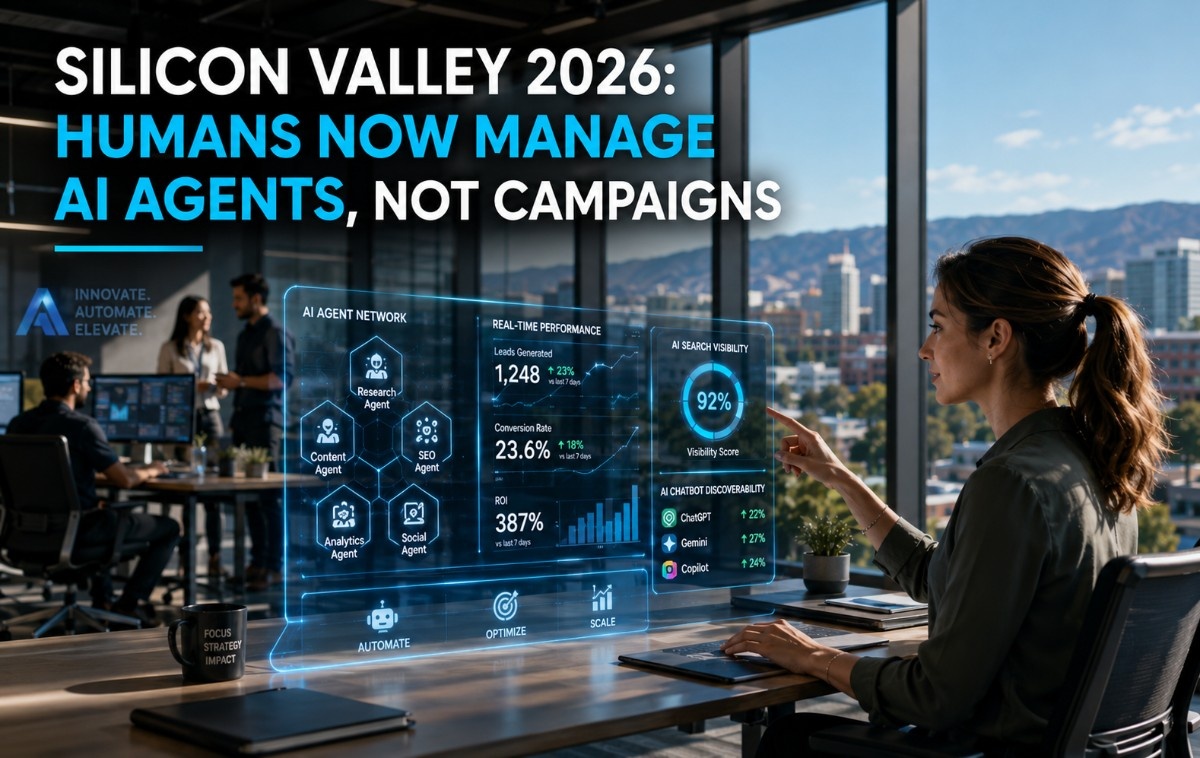
The morning air in Palo Alto still carries that familiar scent of eucalyptus and high-stakes venture capital. But if you walk into any marketing firm from Sand Hill Road to Mountain View today, the vibe has shifted. The frantic clicking of manual campaign adjustments has been replaced by a focused, almost cinematic silence. The era of the "manual campaign manager" didn't just fade away—it hit a wall.
As we move through 2026, the digital marketing landscape has undergone its most radical transformation since the birth of the internet. We’ve moved from "doing the work" to "orchestrating the intelligence." In the high-pressure corridors of Silicon Valley, the most successful marketing leaders no longer spend their days building ad sets; they manage a digital workforce of autonomous AI agents.
The Great Shift: From Task-Doers to Strategic Architects
Back in 2024, most people viewed AI as a helpful sidekick—a way to fix a headline or summarize a long meeting. By 2026, AI has graduated to "Agentic" status. We aren't just talking about chatbots anymore; we are talking about autonomous entities capable of executing entire business workflows from start to finish.
Take a lead generation manager in San Jose, for example. They no longer spend four hours a day manually sourcing prospects on LinkedIn. Instead, they deploy an AI agent. This agent identifies high-intent prospects using Gemini, researches their latest fiscal hurdles via Perplexity, and generates a hyper-personalized outreach strategy using Designs.ai. The human isn't the laborer; the human is the supervisor, setting the ethical guardrails, refining the brand's unique "soul," and making the big-picture calls that a machine simply cannot.
Why Traditional SEO Alone is a Losing Game
If your current strategy is still obsessing solely over Google’s blue links, you’re essentially fighting for a piece of a disappearing pie. The reality on the ground is stark: over 50% of users now prefer AI-generated answers over scrolling through traditional search results. When a potential client asks ChatGPT or Copilot, "Who is the most reliable AI marketing partner in Cupertino?", they aren't looking for a list of ten websites. They want a definitive recommendation.
This shift has created an entirely new discipline: GEO (Generative Engine Optimization) and LLM SEO.
In 2026, success is measured by how often your brand is cited as a primary source within an AI’s "thought process." It’s no longer about keyword density or meta tags in the traditional sense; it's about AI visibility. If your business isn't optimized for AI chatbot discoverability, you effectively don't exist for a massive segment of the market that has moved beyond the search bar.
Comparison: The Traditional Agency vs. Zebra Techies Solution AI Marketing
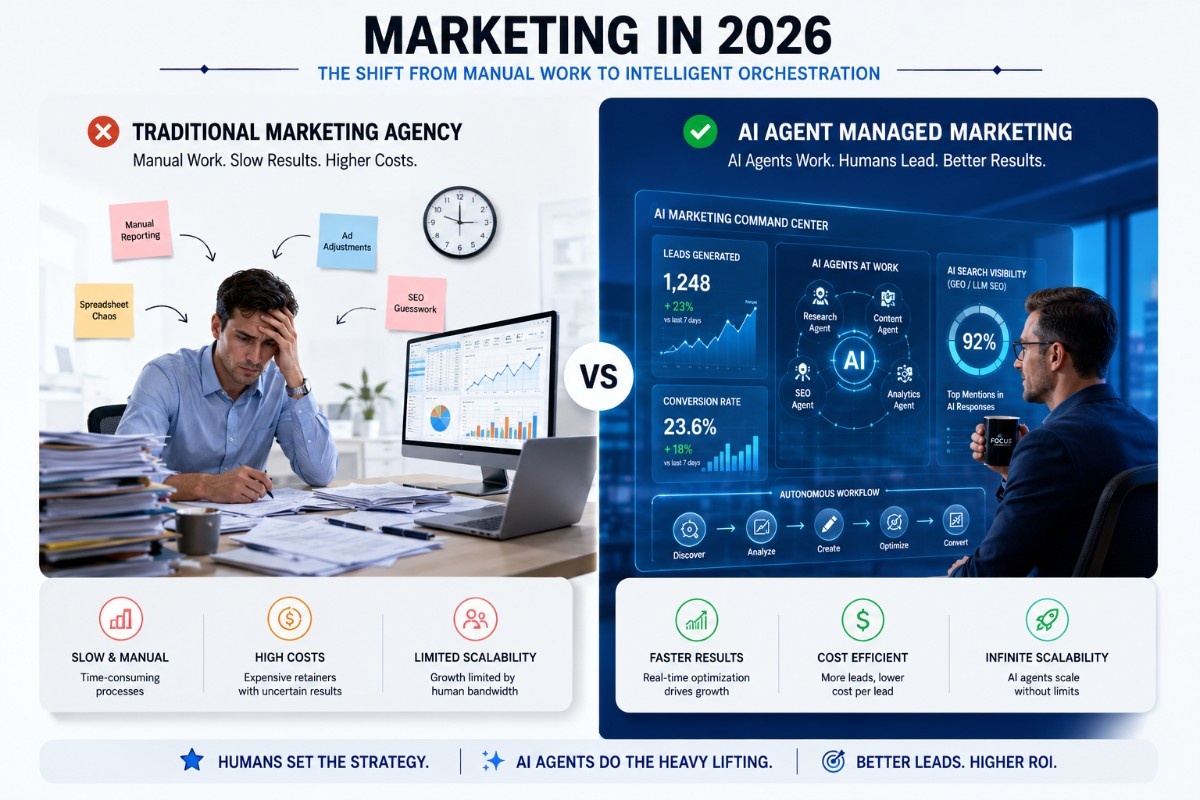
The gap between "the old way" and the "AI-supervised" way has become a canyon. Here is how the landscape looks for a business trying to choose a path:
|
Feature |
Traditional Marketing Agency |
Zebra Techies Solution (ZTS) AI Marketing |
|
Pricing |
High Retainers ($3k - $10k/mo) |
Performance-Driven (Starts at $149/mo) |
|
Workflow |
Human-Heavy & Manual |
AI-Driven Execution + Human Supervision |
|
Lead Generation |
"Best Effort" / Traffic Focus |
Guaranteed 1,000 Leads/Year |
|
Technology Stack |
Standard Analytics & Spreadsheets |
ChatGPT, Gemini, Copilot, Lovable.dev |
|
Optimization Speed |
Weekly/Monthly Reviews |
Real-time AI Micro-Adjustments |
|
Cost Per Lead |
High (Average $150+) |
Minimized via Automated Efficiency |
|
Scaling |
Limited by Agency Headcount |
Scalable through AI Instance Deployment |
Zebra Techies Solution: Your AI Command Center in Silicon Valley
Navigating this transition isn't just a technical challenge; it’s a cultural one. This is where Zebra Techies Solution (ZTS) has carved out a massive footprint for companies in Sunnyvale, Santa Clara, and Menlo Park.
With over 15 years of deep industry expertise and a specialized team of 100+ in-house AI engineers, ZTS has moved beyond the role of a traditional agency. They act as an AI foundry, building custom ecosystems that have already generated over $65 million in revenue for more than 1,200 clients globally.
How ZTS Positions You to Win:
Whether you’re a scrappy startup in Palo Alto or an enterprise firm in San Francisco, ZTS provides the infrastructure needed to thrive in the age of AI-powered marketing. Their tiered service model is designed for the 2026 economy:
- AI Marketing ($149/month): This isn't just about ads; it’s about fixing your AI search rankings so that when users ask questions, your brand is the answer they receive.
- AI Social Media Marketing ($199/month): Deploying intelligent agents that monitor viral trends in real-time and adjust your content strategy before a trend even peaks.
- AI Digital Marketing ($499/month): A comprehensive suite utilizing Google AI Studio and Copilot to handle end-to-end digital presence.
- AI Lead Generation (Starts at $1,000/month): Their flagship offering, which leverages predictive behavioral models to provide a guaranteed 1,000 leads per year.
By focusing on the metrics that actually move the needle—ROI and conversion rates—ZTS ensures that your investment in AI isn't just a "cool experiment," but a primary driver of growth.
Get in Touch with ZTS:
- Website: zebratechies.com/ai-lead-marketing-silicon-valley
- USA Office: +1 (213) 233-1633 | India Office: +91-8910802928
- Direct Email: support@zebratechies.com
By the Numbers: The 2026 Marketing Reality
The data coming out of the first quarter of 2026 tells a story that business owners can't afford to ignore:
- The Conversion Gap: Brands utilizing AI-driven personalization are seeing up to a 23x higher conversion rate than those using static, "one-size-fits-all" campaigns.
- Lead Quality: AI lead qualification has reduced "wasted" sales calls by nearly 50%, as agents can now vet prospects with incredible accuracy before a human ever picks up the phone.
- Operational Speed: Companies have slashed their time-to-market for new campaigns by 60%, using tools like Durable.co and Lovable.dev to build and test landing pages in minutes rather than weeks.
- The Search Evolution: While traditional organic click-through rates have plateaued, being featured in an AI's conversational response has become the single most valuable "placement" in digital media.
Key Takeaways for Navigating the Future
- Strategy Over Execution: Your value as a marketer in 2026 isn't in how well you can use a software tool; it’s in how well you can direct a suite of AI agents.
- Optimization is Changing: You must optimize for "machines that read" (LLMs) just as much as "people who click."
- Guaranteed Results: In an AI world, "vague promises" are out. Services that offer guaranteed lead generation are the new gold standard.
- The Human Edge: As content becomes a commodity, your unique brand voice and human-to-human relationships become your most un-copyable assets.
FAQ: Mastering the AI Marketing Frontier
- Is AI going to eventually replace every marketing role?
It’s a common fear, but the reality is more nuanced. AI is replacing the drudgery, not the discovery. In 2026, we are seeing a massive demand for "AI Strategists"—people who understand the high-level goals of a business and can translate those into prompts and agentic workflows. A machine can analyze data and write a post, but it can't tell you why a certain emotional angle will resonate with a specific community in San Jose. The human at the helm is more important than ever; they’re just doing much more powerful work.
- How does GEO (Generative Engine Optimization) actually work?
Think of it as SEO for the next generation. Instead of just trying to rank on page one of Google, GEO involves structuring your data and brand presence so that models like ChatGPT, Gemini, and Perplexity see your brand as the "authority" on a topic. It involves being mentioned in the right places, having high-quality structured data, and providing clear, fact-based answers that an AI can easily digest and pass on to a user. If the AI trusts you, it will recommend you.
- Why is AI lead generation better than what we had before?
Traditional lead gen was often a "numbers game"—you'd send out 1,000 emails and hope for a 1% response. In 2026, AI agents act more like digital detectives. They analyze massive datasets to find people who are actually in a "buying window" based on their recent digital footprints. This is why firms like Zebra Techies Solution can offer a guaranteed 1,000 leads/year. It’s not a guess anymore; it’s a calculation based on predictive behavioral AI.
- Is this level of technology only for the big players in Mountain View?
Not anymore. The cost of compute has dropped significantly, and specialized agencies like ZTS have packaged this tech into affordable plans. Whether you’re a small law firm in Santa Clara or a boutique shop in Menlo Park, you can access AI Digital Marketing for $499/month. The "barrier to entry" has basically crumbled, which means small businesses can now compete with—and out-maneuver—huge corporations that are too slow to adapt.
- How do I improve my brand's AI chatbot discoverability?
It starts with a shift in your content strategy. You need to create content that answers specific, complex questions rather than just targeting broad keywords. You also need to ensure your brand is cited in high-authority tech and business publications, which AI models use as their "training ground." Working with a team that understands LLM SEO is critical here, as they can help ensure your business becomes part of the "knowledge graph" that these AIs rely on.
Conclusion: The New Dawn of Creativity
As we look at the landscape of Silicon Valley in 2026, it’s clear that we aren't just in a new chapter of marketing—we’re in a new book entirely. The transition from managing campaigns to managing AI agents is the single biggest productivity leap in our professional lives.
But there is a beautiful irony at the heart of this revolution: as the "doing" becomes automated, the "thinking" becomes more valuable. Human creativity, empathy, and high-level strategy are the only things that can't be reduced to an algorithm.
The businesses that will dominate the next decade are the ones that lean into this early. Whether it’s securing your AI search visibility or automating your lead generation, the tools are here. The only real question left for business owners and marketers in Silicon Valley and beyond is: Are you going to be the one who directs the AI, or the one who gets left behind by it?

By Professional qualification a Computer Engineer, By Profession an Online Marketing Strategist and Web Application Development Expert, By Industry position working as a CEO at Zebra Techies Solution!