



The 5-Step Framework for Bug-Proof AI Coding
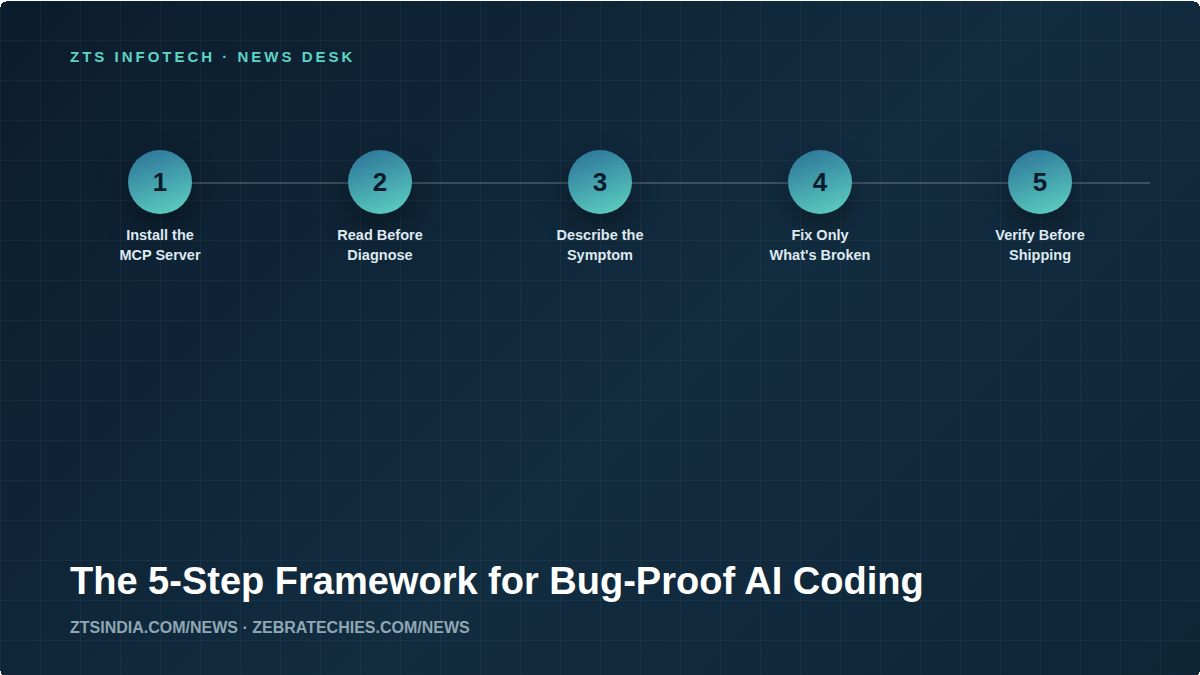
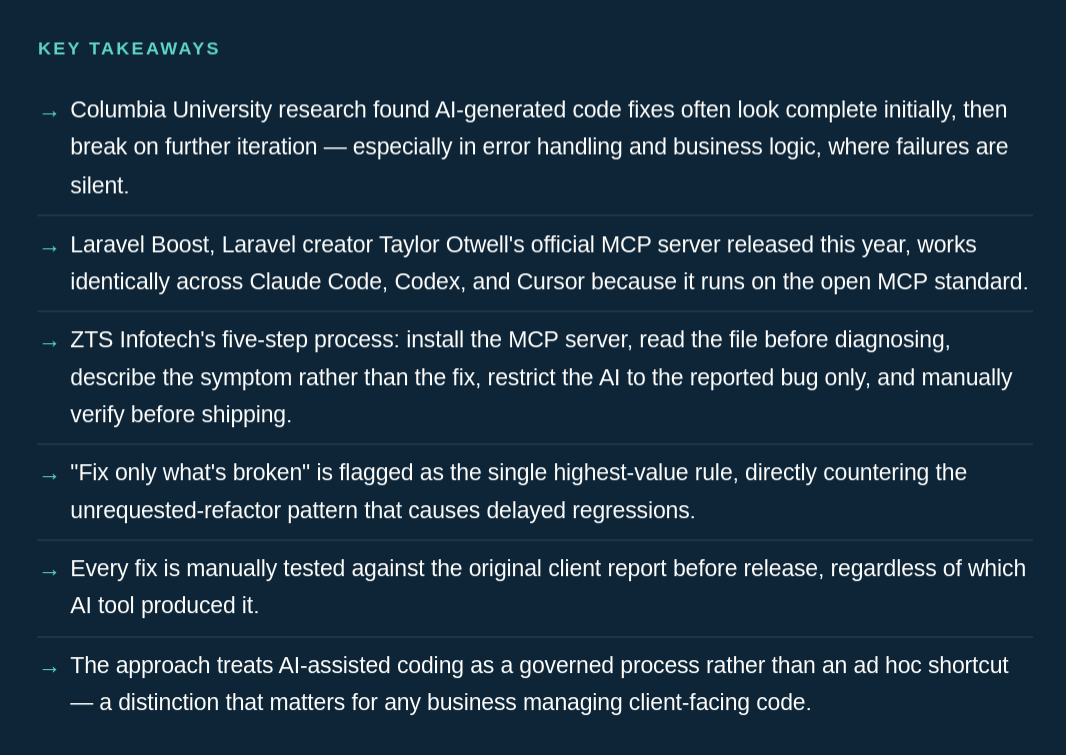
Every agency that has handed a client bug ticket to Claude, Codex, or Cursor has run the same experiment, usually without meaning to: does the fix actually hold, or does it quietly break something else three commits later? ZTS Infotech's News Desk, in a briefing delivered by the company's Anirban Das, lays out the five-step process the firm now runs on every Laravel client portal it maintains — and backs it with a piece of Columbia University research that explains why AI-generated fixes so often look finished and aren't. For agency owners, engineering leads, and any business that has quietly let AI tools loose on production client code, the findings are less a coding tip than a governance problem worth taking seriously.
Why "It Compiled" Isn't the Same as "It's Fixed"
The starting point of the segment is uncomfortable but familiar to anyone running a services business on AI coding tools: a fix that passes the first check can still be wrong. Das cites Columbia University research showing AI-generated fixes tend to look complete initially, then break when the code is iterated on further
— particularly around error handling and business logic, because those failure modes are silent. That distinction matters commercially. A silent regression in a payment or order-status flow does not show up in a demo; it shows up as a client support ticket weeks later, after the work has already been invoiced as done.
The Five-Step Process ZTS Infotech Now Runs on Every Client Portal
Step One: Standardize on an Open Protocol, Not a Vendor
Before any bug gets touched, the team installs Laravel Boost — the official Model Context Protocol server built by Laravel creator Taylor Otwell and released this year. Because Boost runs on the open MCP standard rather than a proprietary plugin format, it connects identically to Claude Code, Codex, and Cursor. That is a meaningful procurement detail: a framework-level MCP server means an agency's tooling investment doesn't lock it into one AI vendor, and switching assistants later doesn't mean rebuilding the integration layer.
Step Two: Read Before Diagnose
The team's rule is simple and, by their account, frequently broken elsewhere: never let an AI agent speculate about a file it has not actually opened. If a client reports a broken checkout page, the agent is pointed directly at the specific controller and model first. Diagnosis follows reading, not the reverse.
Step Three: Describe the Symptom, Not the Solution
Rather than telling the AI what code to write, the team describes what is actually happening — "this order status is not updating after payment" — and lets the model trace the logic itself. Prescribing the fix in advance, Das notes, tends to produce code that satisfies the instruction rather than the underlying problem.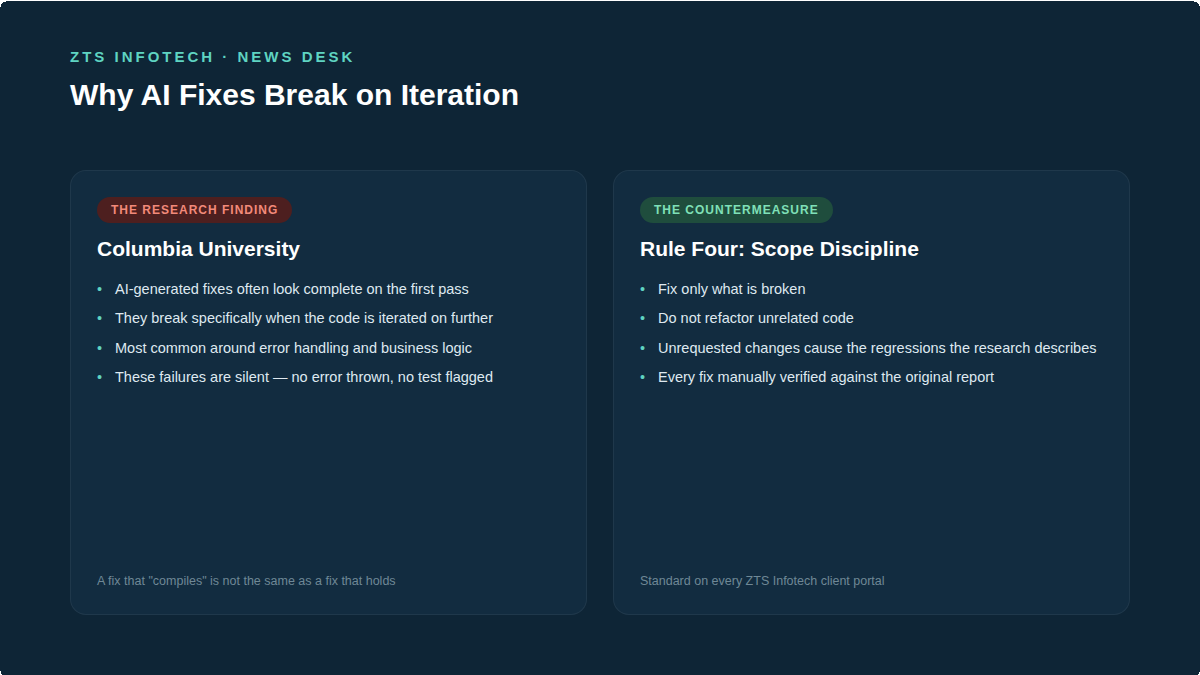
Step Four: Fix Only What's Broken
This is the rule Das calls the most valuable across every tool the team uses. The instruction to the AI is explicit: fix only what is broken, do not refactor unrelated code. Unrequested changes are precisely what turn a five-minute fix into a three-hour regression hunt — and it is this step that connects directly to the Columbia findings on silent iteration failures.
Step Five: Manual Verification Against the Original Report
Every fix, regardless of which AI produced it, is manually tested against the client's original reported issue before it ships. The AI's confidence that a fix works is treated as a starting hypothesis, not a release gate.
Industry Implications: From Coding Trick to Operating Standard
What makes this worth covering as business news rather than a developer tip sheet is the shift it represents. Vibe coding, used casually, has earned a reputation for shipping code that looks right and isn't. This framework operationalizes AI-assisted development the way a mature engineering organization would — with a standard, a review gate, and an explicit scope boundary — rather than treating each AI session as a one-off. For agencies managing dozens of client codebases at once, that discipline separates a productivity gain from a liability.
E X P E R T P E R S P E C T I V E
The most transferable idea here isn't Laravel-specific — it's the discipline of narrowing an AI agent's blast radius before asking it to work. Step four addresses a failure mode that shows up across every framework and every AI coding tool: models are eager to "improve" code well beyond the ask, and that eagerness is exactly what the Columbia research flags as a source ofdelayed, silent breakage. Businesses running any AI-assisted development pipeline — not just Laravel shops — should treat "fix only what's broken" as an enforced policy, not a nice-to-have. Standardizing on an open protocol like MCP is equally strategic: it protects agencies from replatforming their entire AI workflow every time a new coding assistant takes the lead in benchmarks.
Conclusion
The businesses getting reliable output from AI coding tools right now are not the ones with the newest model — they're the ones that turned a fast but sloppy habit into a repeatable process with a verification step at the end. As more agencies formalize how they hand bug tickets to AI agents, expect frameworks like this one, grounded in independent research rather than vendor claims, to become the baseline rather than the exception.

By Professional qualification a Computer Engineer, By Profession an Online Marketing Strategist and Web Application Development Expert, By Industry position working as a CEO at Zebra Techies Solution!