



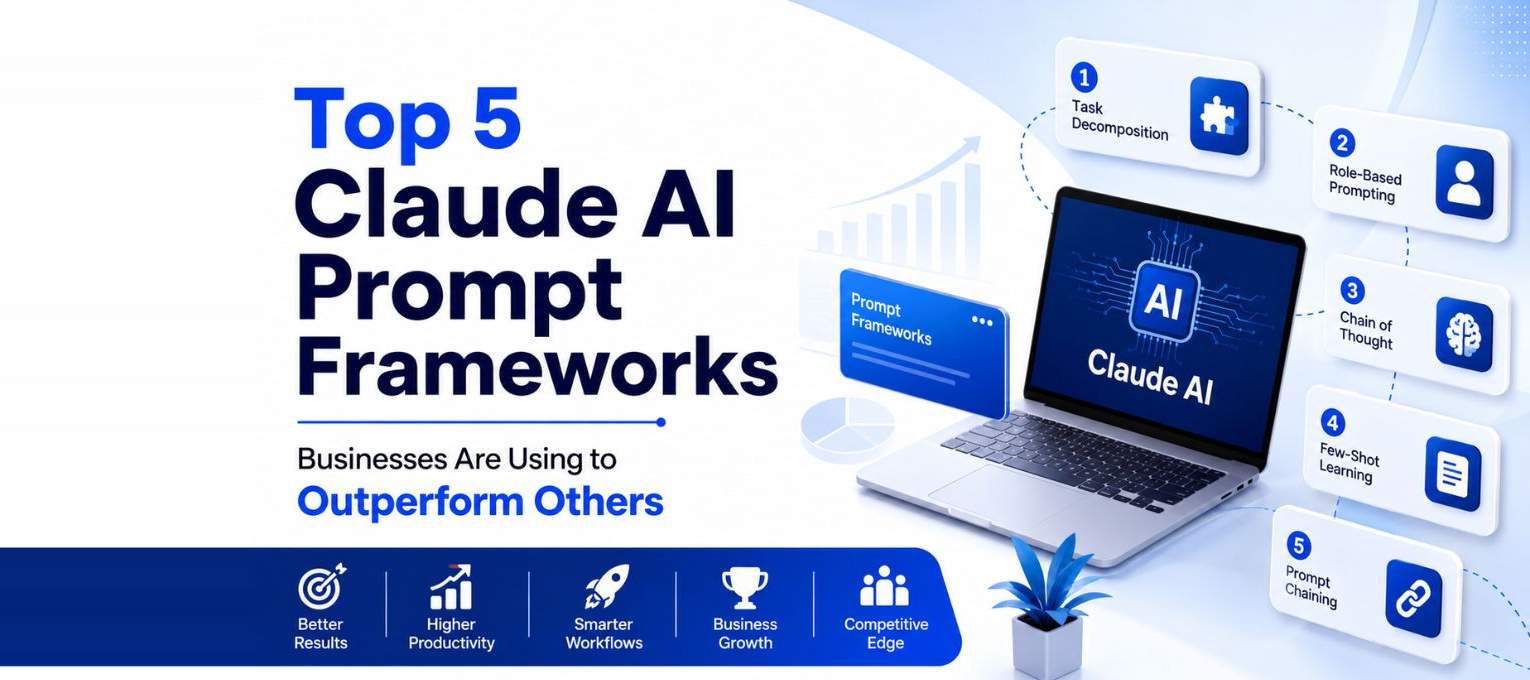
Top 5 Claude AI Prompt Frameworks Businesses Are Using to Outperform Others
Most people treat Claude like a search bar. Type a question, get an answer, move on to the next task. It's not a wrong instinct, exactly — the tool does answer questions perfectly well when used that way. But it also means most people are getting a fraction of what the tool can actually do.
Zebra Techies Solution (ZTS) has been doing digital engineering and marketing work for clients across India, the UK, Europe, and the US for about fifteen years now. In a recent video briefing, their team walked through five prompting approaches they use on live client work — not polished demo examples, but the actual frameworks that show up in day-to-day deliverables. None of them require a coding background. None of them require a paid Claude subscription either.
What Zebra Techies Solution (ZTS) actually shared
The briefing covers five recurring problems that come up constantly in business writing and decision-making, and a prompt structure built to solve each one:
Getting AI writing to sound like a person wrote it, not a template. This is probably the most common complaint about AI-generated copy — it reads fine, technically, but something about it feels hollow. Our CEO, Mr. Anirban Das’s approach is to frame the prompt around tone specifically, rather than just handing over content requirements and hoping for the best.
Pushing past the surface-level answer. Ask Claude a broad question and you'll often get a broad, safe answer back — competent, but generic. The team's second framework is built to nudge Claude into something closer to what a senior consultant would produce: more assumptions stated explicitly, more nuance, less hedging.
Finding the holes in a plan before a client does. This one flips the usual dynamic. Instead of asking Claude to help build something, you ask it to tear apart something that's already built — to go looking for the risk, the gap, the assumption nobody questioned because everyone was too close to the work.
Turning a vague question into an actual decision. A lot of AI output on strategic questions comes back as a loose list of options with no real recommendation attached. Zebra Techies Solution (ZTS)'s fourth framework pushes for something closer to a consultant's memo — trade-offs laid out, a specific recommendation, a next step.
Building something real inside the chat. The fifth item isn't a prompt trick at all — it's Claude's Artifacts feature, which lets a conversation output an actual working thing (a document, a small calculator, some kind of interactive tool) instead of just a paragraph describing what such a thing might look like.
Why any of this matters
Most of the conversation around AI tools happens at the product level — which model is smartest this month, which platform shipped which feature. That's a reasonable thing to argue about, but it skips over something more practical: two people using the exact same tool, on the exact same plan, can get wildly different results depending on nothing more than how they phrase the request.
That's a useful thing to know if you're a business owner trying to figure out whether your AI spend is actually paying off. The plan tier isn't really the bottleneck. Whether your team knows how to ask for depth, or structure, or scrutiny — instead of accepting the first thing that comes back — usually is.
Agencies like Zebra Techies Solution (ZTS) have a pretty direct incentive to get this right, since their output is the client deliverable. If the prompting is sloppy, that shows up in the copy, the strategy doc, the campaign plan — and the client notices before the agency does.
A note on credibility
There's no shortage of "AI prompting tips" content online, and a lot of it is speculative — it looks good in a screenshot but has never been under deadline pressure or in front of a paying client. What's a little different about Zebra Techies Solution (ZTS)'s framing is that they're describing techniques vetted against actual client work over fifteen years, not curated for a video. An agency that gets prompting wrong doesn't get a quiet do-over; they hear about it directly. That's a different, and arguably more honest, bar than most tutorial content is held to.
What this means if you run a business
A few practical takeaways, if you're trying to act on this rather than just read about it:
Review how your team writes AI prompts
If employees are only using short, one-line prompts, they're likely missing out on far better outputs. Well-structured prompts can significantly improve the quality of AI-generated content, research, and decision support.
Create a shared prompt framework library
Build a collection of proven prompts for common business tasks like content creation, market research, customer support, reporting, and brainstorming. This helps every team member achieve more consistent results.
Use AI to identify risks before making decisions
Before finalising a marketing campaign, budget, proposal, or strategy, ask Claude to review it for blind spots, weaknesses, missing assumptions, and potential risks. Think of it as a fast second opinion.
Use Claude Artifacts to build simple business tools
Instead of investing in custom software for every small need, use Claude Artifacts to create calculators, templates, checklists, dashboards, trackers, or internal workflows that save time and improve productivity.
Train your team to use AI effectively
The biggest advantage doesn't come from buying a more expensive AI plan. It comes from teaching employees how to ask better questions, provide clear context, and apply structured prompt frameworks consistently across their daily work.
.jpg)
A few caveats worth keeping in mind
None of this replaces human judgment on anything high-stakes. "Deep mode" output from Claude still needs a person checking facts and sanity-testing the recommendation — it's a better first draft, not a verified expert opinion. And if prompting technique isn't standardized across a team, you'll still get inconsistent quality, just inconsistent at a higher average level than before.
Frequently asked questions
Do you need a paid Claude plan for any of this?
No — these are prompting habits, not premium features. They work the same way on a free account.
Do you need to know how to code?
No. This is about how you phrase a request, not technical configuration, so it's usable by marketing, ops, or client-facing staff with zero development background.
What exactly is Artifacts?
It's a Claude feature that lets a conversation produce a standalone, usable output — a document, a small tool, something interactive — directly in the chat, rather than just text describing what that thing might look like.
How is "finding blind spots" different from just asking a normal question?
Instead of asking Claude to help you build something, you're asking it to critically review something that already exists and flag what the original author might have missed.
Does this only apply to marketing teams?
No. Clear writing, risk review, and structured decisions matter just as much in finance, operations, and HR as they do in content teams.
How do you actually standardize this across a team?
Write it down. A short internal playbook — a handful of go-to prompt structures for tone, depth, risk, and decisions — does most of the work.
The Bottom Line:
The gap between disappointing AI output and genuinely useful AI output usually isn't about the tool. It's about the ask. Zebra Techies Solution (ZTS)'s five frameworks turn that into something teachable — specific, repeatable structures that any employee can pick up without technical training or a bigger budget. For business leaders still treating Claude like a fancier search engine, that's really the update here: not a new feature, just a higher floor for what "good enough" prompting should look like.
For more insights, click here and subscribe to us.

By Professional qualification a Computer Engineer, By Profession an Online Marketing Strategist and Web Application Development Expert, By Industry position working as a CEO at Zebra Techies Solution!